

When you get hurt on someone else’s property, the financial stress often hits faster than the bruises. Medical bills show up immediately, and if you’re missing work, your income can drop at the exact moment you need it most. It’s an unfair setup: the people who most need legal help are often the least able to pay an attorney by the hour.
That’s where contingency fees come in. They aren't mysterious, but they're easy to misunderstand if no one walks you through the details. This guide breaks down how premises liability lawyers typically get paid, what “fees” versus “costs” really means, and what to look for before signing an agreement with a firm like Tim Wright Law. You’ll see common percentage ranges, how trial changes the math, and the questions worth asking before you commit your case.
The whole point of a contingency fee is to give regular people a fighting chance against insurance companies with deep pockets and endless patience. Under an hourly setup, a lawyer bills you for their time no matter what happens—win, lose, settle, or stall. With a contingency fee, the attorney gets paid only if they recover money for you through a settlement or a verdict.
Your lawyer’s incentive lines up with yours under this model. If your case is worth more, both sides care about getting it right. For many injured people, this is the only realistic way to hire experienced premises liability lawyers without draining savings or taking out high-interest loans.
The firm is taking on real risk here. If the case doesn’t succeed, the lawyer typically doesn’t get paid for the time they put in—sometimes hundreds of hours. That’s why firms tend to be picky. While that selectiveness can feel personal, it’s usually just math. A firm that says “yes” is basically saying they believe the case has legs.
Once you understand that basic tradeoff, the next question becomes obvious: what percentage are we talking about?
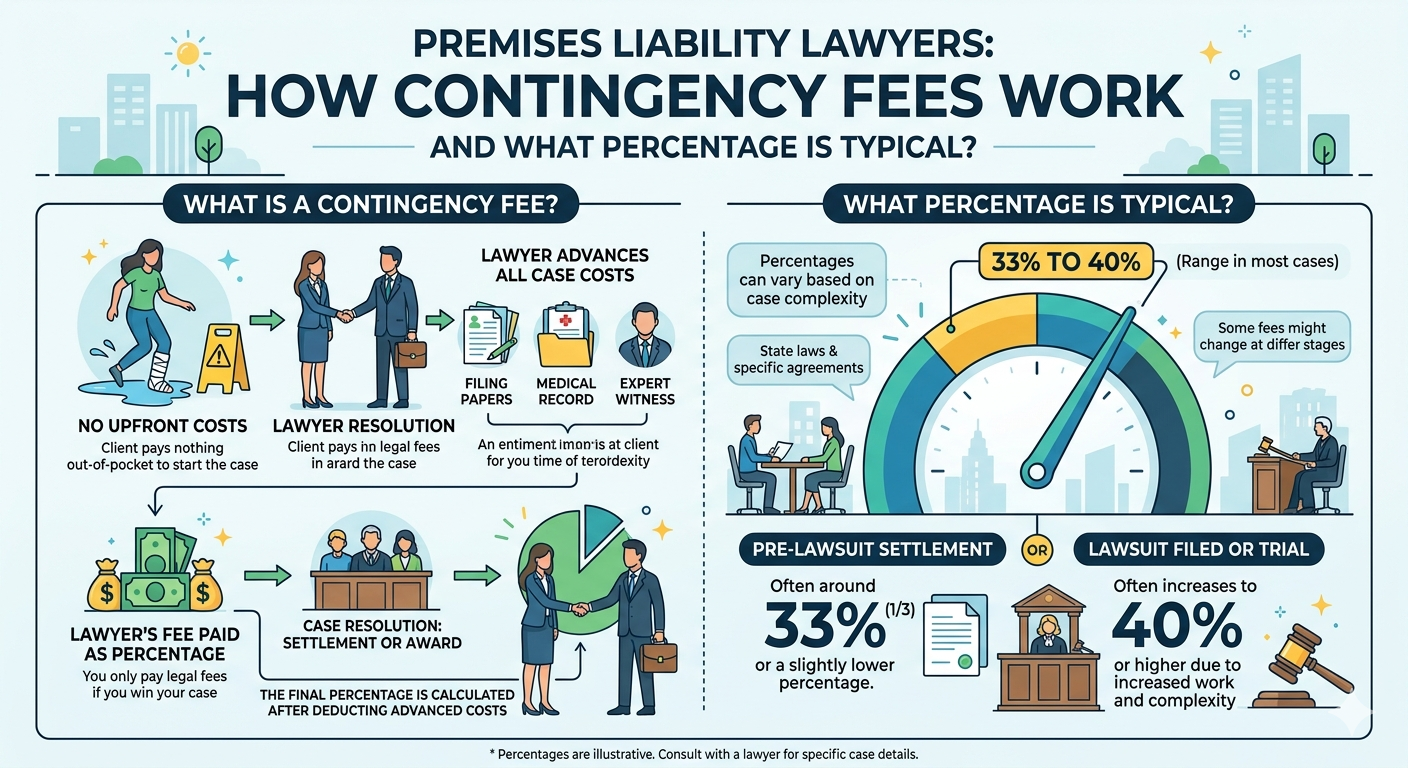
Most premises liability lawyers charge somewhere between 33% and 40% of the total recovery. That range is common for a reason: it reflects the cost of running a litigation practice—staff, case management systems, experts, and depositions—while still leaving the injured person with meaningful compensation.
Some fee agreements are “tiered,” meaning the percentage changes depending on how far the case goes. A case that settles quickly often stays near the lower end. If a lawsuit gets filed or a trial becomes likely, the percentage may increase because the workload and risk jump fast.
Premises cases aren’t all the same. A simple slip-and-fall with clear footage is one thing. A negligent security claim involving a violent assault is another—those can require serious investigation, multiple experts, and a fight over liability that drags out for months. Over the past 18 months, many premises liability lawyers have also seen costs climb for court reporters and medical record retrieval, which influences fee structures.
Tim Wright Law, like many reputable firms, emphasizes clarity upfront so clients aren’t stunned when the case resolves. Transparency matters more than people think.
Many clients assume the contingency percentage covers everything. It usually doesn’t. Fees pay the attorney for legal work. Costs are the out-of-pocket expenses required to build and litigate the case.
Costs can include:
Most firms advance these costs for you and then reimburse themselves from the settlement at the end. The details matter. Some agreements deduct costs before calculating the attorney’s fee; others deduct costs after. That one difference can change your take-home amount by a noticeable amount—sometimes 73% of the confusion in consults comes from this exact point.
You should ask directly what happens if the case loses. Many premises liability lawyers, including those at Tim Wright Law, often don’t pursue clients for costs if there’s no recovery. Not every firm does that. If your contract says you’re responsible for costs regardless of outcome, you could end up owing money even if you never see a settlement. That isn't rare; it’s just not advertised loudly.
Think of it like planning a road trip: the driver may not charge you for the ride unless you reach the destination, but somebody still has to pay for gas and tolls along the way.
How the case ends affects the financial split. Most premises liability claims resolve in settlement, often before a lawsuit is filed. In that stage, the work is substantial but usually more contained—investigation, demand package, negotiation, and maybe a mediation. So the lower fee percentage often applies.
If the insurer digs in, your lawyer may have to file suit and push into discovery. That’s where the workload ramps up. Depositions. Motions. Expert disclosures. Exhibits. Trial prep. Long days and longer nights.
Many contingency agreements account for that by increasing the percentage once litigation begins. It’s not a penalty. It’s a reflection of what it takes to get a case across the finish line when the other side won’t cooperate.
Read your agreement carefully. Ask what triggers the increase and get it explained in plain English.
Before you sign anything, have a real conversation about the money. Not a rushed, hand-wavy one. A contingency agreement is a contract, and you should understand it the way you’d understand a mortgage or a car loan.
Start with the biggest question: Is the attorney’s fee calculated on the gross recovery or the net recovery after costs? That’s a small sentence with big consequences.
Ask this, too, because you’re allowed to: If this gets ugly and goes to trial, what changes financially? A good lawyer won’t dodge that. If a lawyer gets irritated by these questions, that’s a red flag. You’re not being difficult; you’re being careful with your own money.
It’s tempting to shop for the lowest contingency percentage. People do it all the time. The cheapest option isn’t always the best deal—not even close.
A firm charging 30% may not have the resources to hire strong experts or push hard when an insurer plays games. Meanwhile, a firm charging 35% might consistently negotiate higher settlements because they know the adjusters and understand the nuances of the law.
If you switch premises liability lawyers mid-case, does the first attorney keep a lien on your recovery? That’s common, but the terms vary, and you should know what you’re walking into. Pick the firm that makes the agreement understandable and treats questions as normal. Because they are.
Getting injured is already exhausting. Adding confusing legal billing on top of it is the last thing anyone needs. Once you understand how contingency fees work—percentages, costs, and the way trials change the equation—you’re in a much better position to make a smart decision and avoid unpleasant surprises later.
A good contingency arrangement lets you pursue compensation without paying hourly fees upfront. If you choose a firm like Tim Wright Law, the goal is simple: clarity from day one, aligned incentives, and a structure where your legal team only wins if you do. That’s how this system is supposed to work—regular people standing a real chance against property owners and insurers who’d rather you just go away.
In most contingency fee arrangements, if you don't recover any money, you don't owe the attorney any legal fees. However, you must clarify whether you'll be responsible for out-of-pocket costs like filing fees or medical record charges.
While most premises liability lawyers have standard rates, there is sometimes room for negotiation depending on the clarity of liability and the size of the potential recovery. It's always worth asking before you sign the contract.
No, the fee covers the lawyer's time and expertise. The costs for hiring experts are separate expenses that are typically advanced by the firm and then deducted from your final settlement amount.
Trials require a massive investment of time, staff resources, and preparation. The higher percentage reflects the increased risk and the significant workload required to present a case before a judge or jury.
Most premises liability lawyers offer free initial consultations. This allows them to evaluate the merits of your case and allows you to ask questions about their fee structure without any financial commitment.
If you've been injured on someone else's property, don't face the insurance companies alone. Our team of experienced premises liability lawyers is ready to fight for the compensation you deserve with total transparency and no upfront costs. Contact Tim Wright Law today for a free, no-obligation consultation to discuss your case and learn how we can help you move forward.
Contact Tim D. Wright, Personal Injury Attorney
📍 Burbank Office: 1112 W. Burbank Blvd., Suite 302, Burbank, CA 91506
📍 Van Nuys Office: 16555 Sherman Way, Suite B2, Van Nuys, CA 91406
📞 Phone: (323) 379-9995 (Personal Injury) | (818) 428-1080 (Workers’ Comp)
📧 Email: firm@timwrightlaw.com
🌐 Website: www.timwrightlaw.com
📱 Follow us on Facebook, Instagram, and Twitter


