

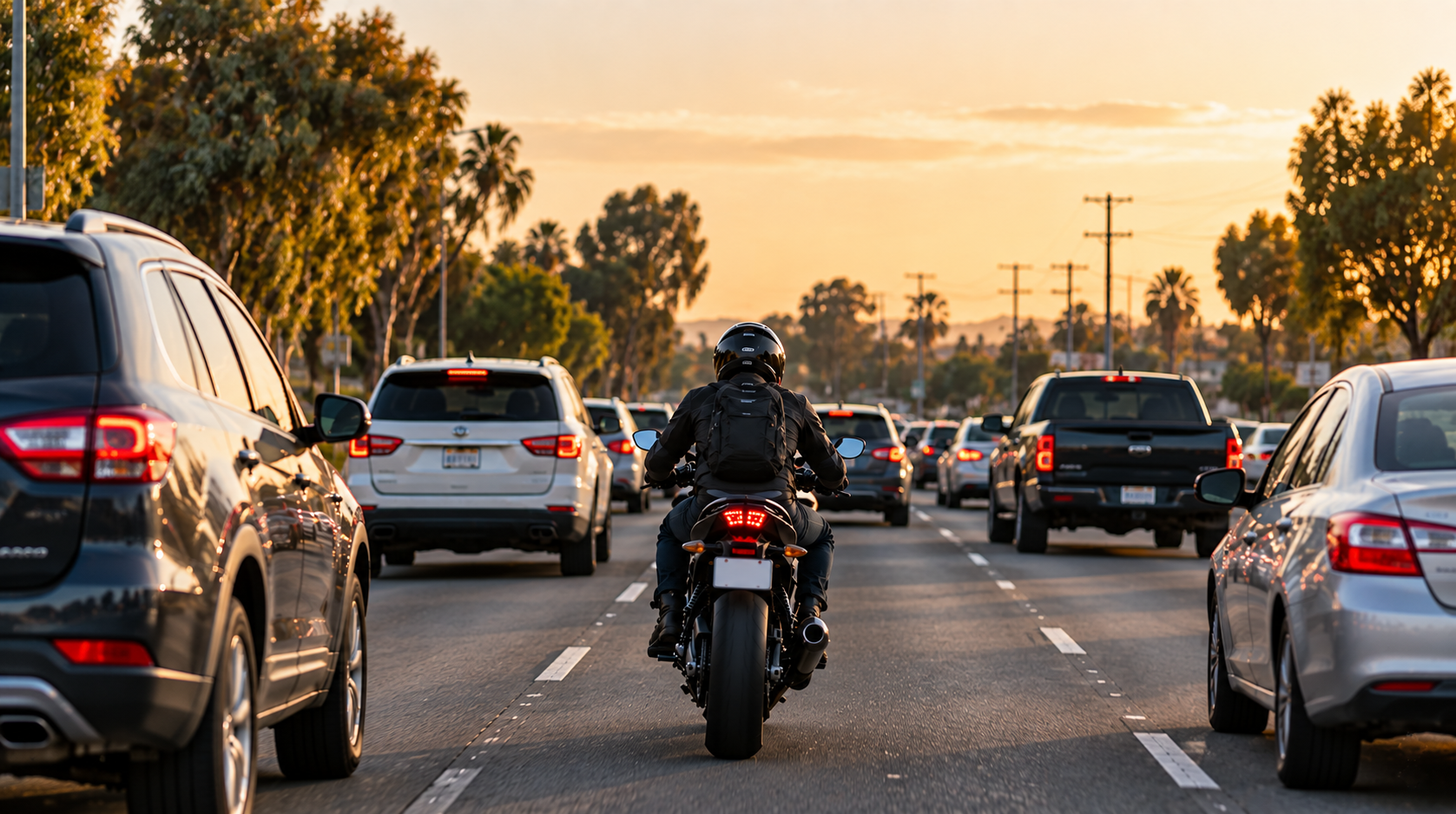
California motorcyclists have a unique option that riders in many other states don't: lane splitting. When traffic slows or stops, a motorcyclist may ride between rows of vehicles rather than remaining in a traffic lane.
So, is lane splitting legal in California? Yes. But legal doesn't mean risk-free, and it doesn't automatically determine who is responsible if an accident occurs.
Understanding what California law says—and how lane splitting may affect an accident claim—can help both riders and drivers make safer decisions on the road.
California Vehicle Code Section 21658.1 defines lane splitting as operating a two-wheeled motorcycle between rows of stopped or moving vehicles in the same lane. The law took effect January 1, 2017, after Assembly Bill 51 was signed in 2016.
California law also authorizes the California Highway Patrol to develop educational safety guidelines for motorcyclists who lane split.
The important point is that lane splitting itself is legal in California. However, riders still have to follow other traffic laws and operate their motorcycles safely.
California law doesn't establish a specific speed limit that applies only to lane splitting.
This is one area where the original draft needed correcting. Older lane-splitting guidance is sometimes summarized as "don't travel more than 10 mph faster than traffic" or "don't split when traffic exceeds 30 mph." Those numbers are not part of CHP's current published lane-splitting safety tips.
Instead, CHP advises riders that the danger increases as their overall speed and the speed difference between the motorcycle and surrounding traffic increase.
Although every traffic situation is different, CHP provides several practical recommendations for riders who choose to lane split.
Motorcyclists should consider traffic speed, lane width, surrounding vehicles, road conditions, weather and visibility before deciding whether it's safe.
CHP also advises riders that it is typically safer to split between the far-left lanes, avoid lingering in vehicle blind spots and use additional caution around large vehicles such as buses, motorhomes and big rigs. Riding on the shoulder is illegal and isn't considered lane splitting.
These recommendations don't eliminate the possibility of an accident, but they illustrate why the circumstances surrounding a rider's lane splitting matter.
Motorcyclists aren't the only ones responsible for preventing lane-splitting accidents.
Drivers should check their mirrors and blind spots before changing lanes and remain alert for motorcycles traveling between lanes.
CHP also states that intentionally blocking or impeding a lane-splitting motorcyclist in a way that could cause harm is illegal.
A sudden lane change, failure to notice a motorcycle or other unsafe driving behavior can contribute to a serious motorcycle accident.
Whether lane splitting is appropriate depends heavily on the circumstances.
Traffic speed, the difference in speed between the motorcycle and surrounding vehicles, visibility, road conditions and the amount of space available can all affect risk.
For example, moving between nearly stopped vehicles at a cautious speed presents a very different situation from traveling between vehicles at a high speed.
CHP specifically warns that the risk of death or serious injury during a lane-splitting collision increases as speed and speed differential increase.
For riders, the decision to lane split should always account for what's happening around them rather than simply whether the practice is legal.
Lane splitting doesn't automatically make a motorcyclist responsible for an accident.
California uses a comparative-fault system, which allows responsibility for an accident to be divided among the people involved. That means the actions of both the motorcyclist and driver may need to be examined.
Investigators may consider whether the rider was traveling at an unsafe speed, whether the driver checked their blind spot, whether a turn signal was used, traffic conditions, visibility and where the vehicles were immediately before the collision.
For example, a driver who suddenly moves into another lane without properly checking for a motorcycle may bear responsibility for a crash. At the same time, a rider's unsafe speed or other conduct could also become relevant.
Because lane-splitting accidents can involve conflicting accounts of what happened, evidence can become especially important.
Motorcycle crashes can happen quickly, and the positions of the vehicles may change before police or investigators arrive.
If you're able to do so safely, try to preserve information such as:
Photos showing the surrounding traffic conditions may be particularly useful in a lane-splitting case.
Your health should come first. Call 911 when appropriate and seek medical attention, even if an injury doesn't initially seem severe.
Motorcycle accidents can cause head, neck, back and other injuries that aren't always immediately apparent.
After receiving medical care, keep records related to the accident and your recovery. That can include medical bills, prescriptions, missed work, repair estimates and communications with insurance companies.
You also don't need to decide for yourself who was at fault before getting more information. A motorcycle accident lawyer can review the evidence and explain how California's lane-splitting and comparative-fault rules may apply.
Lane splitting is legal in California, but every accident involving it has to be evaluated based on its own circumstances.
The fact that a motorcyclist was riding between lanes doesn't automatically establish fault. What the rider, driver and surrounding traffic were doing immediately before the collision can all matter.
If you've been injured while riding a motorcycle, Tim Wright Law can review what happened, explain your options and help you understand the next steps in a California personal injury claim.


