

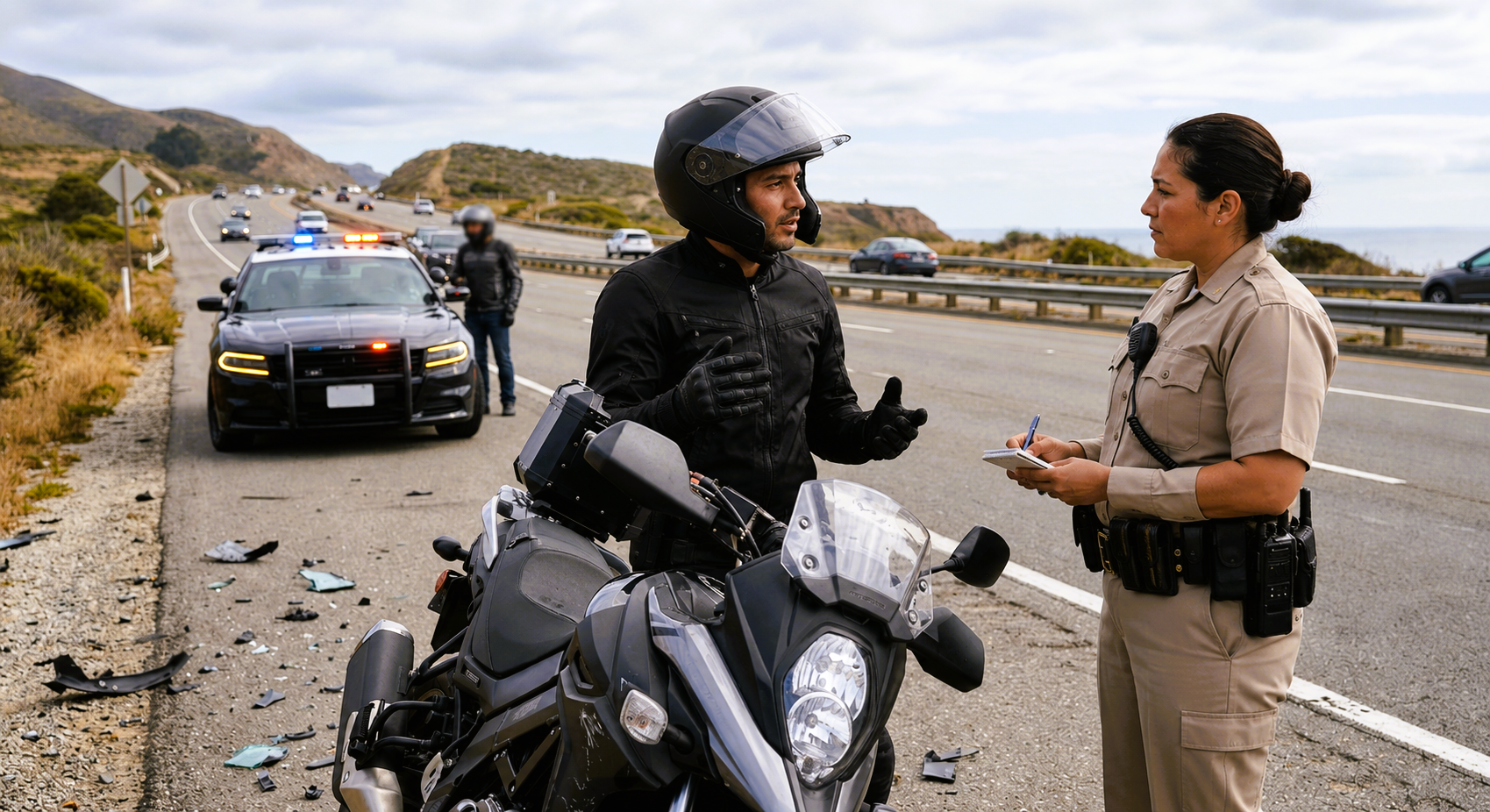
A rider can follow the traffic rules and still hear the same assumptions after a crash: the motorcycle must have been speeding, the rider must have been weaving, or the risk was simply part of riding. Those assumptions are not evidence.
Tim D. Wright has practiced personal injury law in Southern California since 1983. Motorcycle accident rights in California are assessed through the conduct of everyone involved, the roadway, the physical evidence, and the injuries, not through a stereotype about the person on two wheels.
A motorcyclist has the right to use California roads while following the laws that apply to motorcycles and other vehicles. The claim should begin with the same core questions asked in any negligence matter: who owed a duty of care, what conduct fell below that duty, what caused the collision, and what harm followed?
The driver's report at the scene is a one piece of informations and not the final account. A motorist may say the motorcycle appeared suddenly, while video, sight-distance measurements, damage patterns, or witness accounts may show that the motorcycle was visible for several seconds.
The physical vulnerabilities has also change the injury analysis. The rider may strike the road, another vehicle, or a fixed object without the protection of a passenger compartment, so medical records and protective gear should be documented carefully.
All road conditions can create a motorcycle-specific sequence even when every motorcycle remains upright. Gravel, pavement seams, potholes, fluid, construction plates, and poorly visible lane markings may affect steering or braking, while a passenger vehicle may cross the same area with little obvious movement.
Get two shots of any road condition you think contributed to the crash, one close enough to show the defect clearly, and one pulled back far enough to capture the travel path and where it sits in relation to everything else.
When possible, keep the motorcycle, helmet, jacket, gloves, boots, camera footage, phone photos, and repair records. Do not repair, replace, or throw away damaged gear until you know whether it could help show where the impact occurred, what was visible, or how much force was involved.
The firm's motorcycle accident practice evaluates the collision and injury evidence separately. A serious injury does not prove fault, and proof of unsafe driving does not automatically establish the full extent of the damages.
California Vehicle Code section 21658.1 defines lane splitting as driving a two-wheeled motorcycle between rows of stopped or moving vehicles in the same lane. The statute also authorizes the California Highway Patrol to develop educational safety guidelines.
Having a legal definition doesn't settle much on its own. Whether a lane-split was reasonable in a given situation still comes down to what was actually happening on the road, how fast traffic was moving, how wide the lanes were, what was visible, whether signals were being used, how other vehicles were behaving, and where the impact ultimately occurred.
For example, a driver may begin a lane change without checking mirrors while a rider is moving between slow traffic. In another situation, a rider's speed or position may become part of the comparative-fault analysis.
Turning movements are one of the most contested areas in motorcycle crashes. A driver cuts across a rider's path while pulling into a driveway or swinging through a left turn, then walks away convinced the motorcycle came out of nowhere or was moving too fast to anticipate.
California's 2026 civil jury instructions include comparative-fault directions that allow responsibility to be apportioned when a plaintiff's negligence is also at issue. An insurer's claim that the rider shares fault should be tested against the complete record rather than accepted as a reason to end the claim.
Take note of the lane markings, the gaps between vehicles, how fast traffic was moving, where signals were in their cycle, and whether mirrors and turn signals were actually used. Just as important: where did each vehicle first come into view?
California Vehicle Code section 27803 requires a motorcycle driver and passenger to wear a qualifying safety helmet on the highway. The helmet must be on the person's head, fastened, and properly sized as described by the statute.
Whether someone was wearing a helmet and who caused the crash are two separate questions, and they shouldn't be treated as the same one. If a driver cut across the rider's path, followed too close, swung a door open, or drifted lanes without checking, that conduct has to be worked through the crash evidence on its own terms.
When helmet use does come up, the analysis gets more specific. What injury is actually being claimed? And did the alleged noncompliance have anything to do with how that injury happened? A broad argument about safety equipment isn't a substitute for the medical and technical evidence that answers those questions directly.
Keep the helmet exactly as it was after the crash and take photos from every angle. Scratches, cracks, visor damage, and impact marks may help a qualified expert understand what happened, but looking at the helmet alone cannot determine whether an injury occurred.
A passenger has rights too. The conduct of the motorcycle operator, another motorist, an owner, or another responsible party may need review, and a passenger should not assume that riding on the motorcycle prevents a claim.
Other protective equipment may be relevant to injury mechanics, but it should not become a substitute for the collision analysis. Clothing damage, boot marks, and glove abrasions may help show contact and sliding, while medical professionals remain the proper source for diagnosis and treatment.
The scene won't stay the way it is for long. Request medical help, report the crash, photograph the road and the vehicles, and get the names of anyone who saw what happened, all of it, as quickly as you can.
Write down everything you can while it's still fresh, the route you were on, how fast traffic was moving, where each vehicle was in the lane, what signals were in use, the weather, the lighting, and what protective equipment was being worn. If the other driver said anything at the scene, get that down too, word for word as best you can recall.
Police reports are worth getting early. They can contain driver statements, witness names, scene diagrams, citations issued, and the responding officer's own observations, all useful starting points.
Readers seeking a wider overview of the legal process after a motorcycle accident can review the firm's related article. The discussion here concentrates on rider rights, lane splitting, helmet arguments, and evidence-based fault evaluation.
Keep copies of all insurance communications. Before giving a recorded statement or signing a release or medical authorization, make sure you understand why the insurer is requesting it. The insurance company may compare your early statements with later testimony, electronic data, photographs, and medical records.
What gets documented in your medical records matters more than most people expect. Symptoms, examination findings, treatment, how recovery is progressing, all of it should be recorded as accurately as possible.
California Code of Civil Procedure section 335.1 generally provides a two-year period for an action involving injury caused by another person's wrongful act or neglect. Claims involving a public entity, a defective roadway, a minor, or other special circumstances may require a different analysis.
Public-road complaints can involve a government claim procedure with a much shorter presentation period than the ordinary injury filing period. The correct public entity, accrual date, and procedural obligations should be checked promptly rather than inferred from who maintains the street.
Motorcyclists in the San Fernando Valley service area may travel daily through Burbank, Glendale, and North Hollywood. The same California rules apply, but the available cameras, road design, traffic movement, and potential parties will differ from one location to another.
No two cases land the same way. But a rider's position is strongest when the argument is built on something solid, evidence that was preserved early, medical records that accurately reflect what happened to the body, a clear read on current law, and a direct line drawn between the other party's conduct and the harm that followed.
No, and that's a common misconception worth clearing up. California law recognizes lane splitting, but recognizing it and calling it safe in every situation are two different things. Fault comes down to how the rider and the other drivers actually behaved given the conditions at that moment, speed, visibility, how lanes were being used, whether signals were on, and where the impact happened. Tim D. Wright looks at all of that before any conclusion about responsibility gets drawn.
A helmet issue does not automatically answer who caused the collision. It may become relevant to a claimed injury only when the law, medical evidence, and causation support that connection, and comparative fault may affect the analysis.
That statement should be compared with sight lines, lighting, traffic speed, video, witnesses, damage, and the driver's opportunity to look. Motorcycles can be overlooked, but the phrase itself is not proof that the rider was invisible or unsafe.
The Law Offices of Tim D. Wright maintains its primary personal injury office in Burbank and serves the surrounding Southern California area. The firm offers a free consultation, but the available options and results depend on the evidence and circumstances of the individual crash.
Do not let a stereotype become the accepted version of your motorcycle crash. Request a free consultation with the Law Offices of Tim D. Wright at (323) 379-9995 or through the contact page so the roadway evidence, rider conduct, driver conduct, and injuries can be considered together.


