

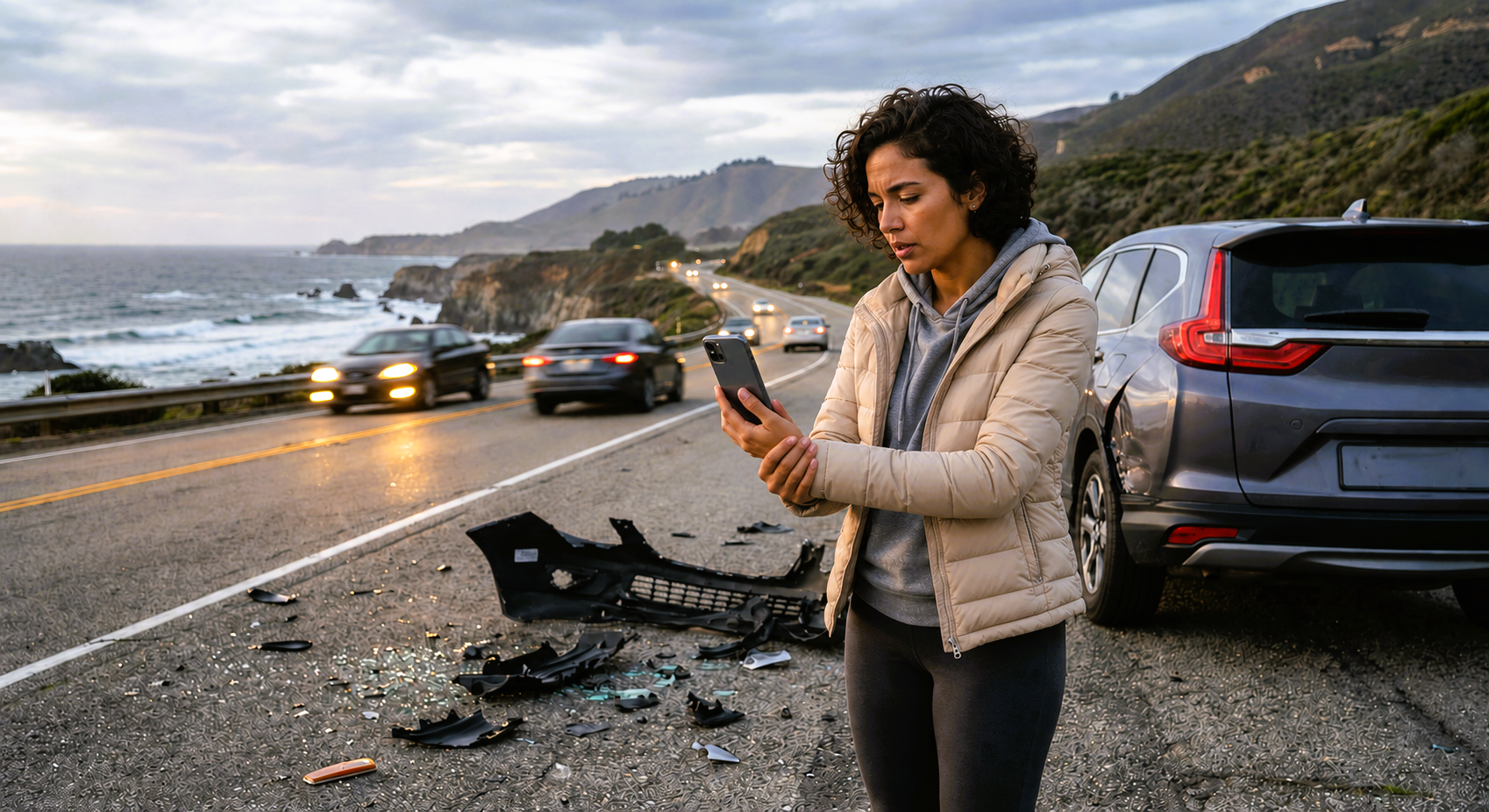
The vehicle that caused the crash may disappear before you can read the plate, but the scene still contains information. Your safety, the police report, witness memories, debris, cameras, and your own insurance records can all matter after the driver is gone.
Tim D. Wright has practiced personal injury law in Southern California since 1983. Knowing what to do after a hit-and-run accident in California can protect health and preserve possible claim options, although identifying the driver or acquiring coverage can never be guaranteed.
Pull over as close to where it happens, which may not be the exact spot and does not need to be. Make sure your hazards are on. Check yourself and anyone with you because adrenaline hides a lot in the first few minutes. Call 911 if someone might be hurt or the road is still dangerous where you are sitting. And whatever the instinct says, do not go after the other car, because chasing someone turns one crash into the possibility of two.
Do not pursue the fleeing vehicle. A chase can create another collision, place passengers along with other road users at risk, and make it harder for officers to document where the first impact occurred.
Tell the dispatcher that the other driver left and provide the direction of travel, vehicle description, partial plate, visible damage, and number of occupants. State what you actually observed and separate it from what a witness later tells you.
Under California Vehicle Code section 20001, a driver involved in a collision resulting in injury or death must immediately stop and fulfill specified duties. The fleeing driver's violation does not by itself prove every element of a civil injury claim, but it makes prompt reporting especially important.
Vehicle Code section 20003 addresses identifying information and reasonable assistance after an injury collision. When the other driver leaves, the police report creates an official record that those exchanges did not occur at the scene.
Make and model if you know them, or just the body type and color if you do not. Roughly what year it looked like. Whatever you caught of the plate. Bumper stickers, company markings, the wheel style, a broken taillight, damage that looked new. Any of it. And here is the part worth remembering: three plate characters plus a silver hatchback heading north on a named street is worth far more than seven characters you are only mostly sure about. A partial you are certain of beats a full plate you invented under stress, because the guess sends everyone chasing the wrong car.
Describe the driver or occupants only if you had a reliable view. Include where you were positioned, how long you observed the vehicle, and any limits caused by distance, lighting, motion, tint, weather, or injury.
Walk all the way around your car and shoot every side, not just the damaged one. Get in close on the point of impact, any paint transfer, whatever broke off. Then step back for the debris field, tire marks, lane lines, signals, signs, the road surface itself, the lighting. Shoot the way you came in and the way traffic was leaving, because those two angles tell people later what each driver could see. One more thing. Keep the originals untouched. Crop and mark up a copy if you want to point something out, but do not do it to the only file you have, because the original is what carries the timestamp and the location data.
Look for parts left behind, but do not stand in traffic or handle sharp debris. Officers or an investigator may be able to connect a mirror housing, light fragment, paint, or trim piece to a vehicle category.
Ask witnesses for names, phone numbers, and a short description of what they personally saw. A witness in another lane may have captured a plate or noticed the fleeing vehicle before you did.
Readers who want a wider regional checklist can review the firm's Inland Empire hit-and-run guide. The discussion here concentrates on the statewide reporting, insurance, and evidence requirements that can affect an injury claim.
Look around. Traffic cameras at the intersection, a bus that went through, storefronts facing the street, a doorbell camera on a house, the parking structure across the way, a delivery van sitting at the curb, anybody with a dashcam. Cameras are everywhere now and most of them overwrite in a matter of days.
Write down where each one is and the exact window you need, down to the minute if you can. Nobody at that business is going to sit through six hours of footage guessing at what you want, and if the request is vague, the answer is usually that nothing was found.
A camera may show only the vehicle entering or leaving the area, but that can establish direction, timing, color, damage, or part of a plate. Footage from several locations may create a sequence even when no single video captures the impact.
Ask them politely to hold onto the footage from that window. That is the whole request. Do not push for a copy on the spot, do not walk into anywhere you were not invited, and do not tell a business owner they are required to hand anything over to you, because they are not. Plenty of footage only comes loose through a police request, a subpoena, a preservation letter, or some other formal process, and someone who felt strong-armed at the counter is far less likely to still have the file when that process catches up.
Preserve your phone's call log, location history, photographs, videos, navigation data, and messages related to the crash. If your vehicle has a dashcam or connected system, save the clip before the device loops over it.
The shop and the tow yard hold evidence too, and most of it disappears the moment work begins. Ask them to photograph the damage before anything comes apart, and ask them to set aside whatever they pull off the car. Paint transfer from another vehicle sits on your bumper until somebody sands it down. A cracked piece of trim that came from the other car can turn out to be the thing that identifies it. Shops will usually do this if you ask up front. Almost none of them will think of it on their own.
Do not post the partial plate or an unverified accusation naming a person online. Incorrect public identification can harm an uninvolved person and distract from the evidence being provided to law enforcement.
Your medical file is about your body: what the ER found, what you told them hurt, what the diagnosis turned out to be, what treatment followed, and how the recovery has actually gone since. The police report is about the crash, meaning where it happened, who was there, what witnesses said, what the vehicles showed, and what the officer did to look into it. Both matter, but the report says nothing about whether your shoulder still works.
Go by how you feel and what a doctor tells you, not by how the car looks. Plenty of people walk away from a crumpled bumper with something torn in the neck, and plenty of people walk away from a totaled car fine. Adrenaline covers a lot for the first day or two. And months later, when an insurer starts arguing that your injury had nothing to do with the crash, the gap between the impact and your first visit is the first thing they point at.
Tell the doctor everything, including the shoulder you hurt playing ball six years ago if it is the same shoulder. This is not about reciting the same sentences every visit. It is about being clear on what was already going on before the crash and what is new since, because those are two different things and only one of them belongs to the other driver.
Get the incident number before you leave the scene, along with which agency responded, the officer's name and badge, and how to request a copy. Read the report once it comes through. If something in it is flat wrong, the agency has a process for that, and there is usually a way to add information the officer did not have at the time.
California drivers may also have separate reporting obligations. The California DMV accident-reporting guidance explains when an SR-1 report is required, including specified injury, death, or property-damage circumstances.
The firm's car accident practice can review the medical, police, vehicle, and insurance records together. A police report may support the timeline, but it does not automatically establish civil liability or insurance coverage.
When the fleeing driver is not identified, the injured person may need to examine uninsured-motorist coverage, medical-payments coverage, collision coverage, or other policy provisions. Coverage depends on the policy, the insured status of the person making the claim, the type of loss, and compliance with applicable requirements.
California Insurance Code section 11580.2 contains specific conditions for treating an unknown hit-and-run vehicle as uninsured for bodily-injury coverage. The statute includes physical-contact, police-reporting, and sworn-statement requirements that should be reviewed immediately.
For the statutory unknown-driver provision, the bodily injury must arise from physical contact involving the unknown vehicle. The statute also calls for reporting the accident to the appropriate police agency within 24 hours and filing a sworn statement with the insurer within 30 days afterward, subject to the precise statutory language and facts.
Uninsured-motorist bodily-injury coverage should not be confused with payment for vehicle damage. Section 11580.2 contains limitations, and collision or other property coverage may depend on different policy terms, deductibles, and proof.
Call your own insurer early and ask them straight out what they need from you. Which reports. Whether they want a statement, and in what form. What authorizations they are asking you to sign. Whether they need to inspect the car, and by when. Then keep a copy of everything you send them, with the date, who you sent it to, whatever confirmation came back, and the claim number written on it. That habit takes a few seconds and it settles arguments six months later.
The harder part is that paying premiums for years does not mean every hit-and-run loss lands inside your coverage. What the policy actually says, what the endorsements add, what the exclusions carve out, anything you signed a waiver on, who counts as an insured person under that policy, whether the vehicle qualified at the time, and what the statute requires all have to be read against this particular crash. That is a real answer, not a brush-off, and it is why nobody who has not seen your policy should be telling you what it covers.
Police do find these drivers. Camera footage turns something up, a piece of trim in the road matches a make and model, a witness remembers enough of a plate for a reader to hit on it, a body shop reports a suspicious repair, or the driver surfaces months later on their own. Finding someone is not the end of it, though. Who owned that car, whether the driver had permission to be in it, what insurance was in force, whether the person police found was actually behind the wheel, and whether that driver caused the crash all still have to be proven. And none of that pauses your filing deadline while it gets sorted out.
A criminal investigation and a civil or insurance claim serve different purposes and may move at different speeds. Do not wait for an arrest or charging decision before preserving medical records, insurance rights, and civil evidence.
Code of Civil Procedure section 335.1 generally provides two years for an injury action based on another person's wrongful act or neglect. Insurance contracts, uninsured-motorist procedures, government involvement, minors, and other circumstances may create additional requirements.
Get hit by a driver who takes off in Burbank and the footage you need could sit with four different owners. A city camera at the intersection. The dry cleaner whose lens happens to point at the street. A bus that rolled through a minute later. Caltrans, if any part of it happened on or near a freeway. Knowing exactly where you were tells you who to send the letter to. It does not tell you how the case turns out.
Because these cases turn on things that shift from one to the next. Whether the driver ever gets identified. Whether the cars actually touched. How fast it got reported, what your policy says, how badly you were hurt, what it has cost you, and what evidence is still around by the time anyone goes looking. Moving early keeps your options open. It does not promise anyone will find the driver, and it does not promise a policy will cover what happened to you.
No. Stop safely, call 911, and provide the vehicle description, partial plate, direction of travel, and other observed details. Tim D. Wright explains that preserving your safety and the current scene is more useful than creating the risks of a pursuit.
More than you would think. Three characters and a direction of travel can be enough to work with, especially paired with a make and model, or even just a body style and color. Fresh damage helps a lot, since the other car is now driving around with a dent that matches yours. So do bumper stickers, company lettering on a door, an unusual wheel, and anything you noticed about who was inside. Write down only what you actually saw, though, and say so plainly if the light was bad or it happened too fast to be sure. A short honest account is worth more than a long one somebody has to walk back later.
It may apply to bodily injury when the policy, insured status, statutory physical-contact rule, reporting requirements, and other conditions are satisfied. California Insurance Code section 11580.2 should be reviewed with the actual policy immediately.
The Law Offices of Tim D. Wright offers a free consultation and can review the police report, vehicle evidence, physical-contact facts, insurance policy, injuries, and deadlines. The firm cannot promise that the driver will be identified or that coverage will apply.
The other vehicle may be gone, but cameras, debris, witness memories, and insurance deadlines are still moving. Request a free consultation with the Law Offices of Tim D. Wright by calling (323) 379-9995 or using the contact page to discuss the report, evidence, policy, and immediate steps that may apply.


