

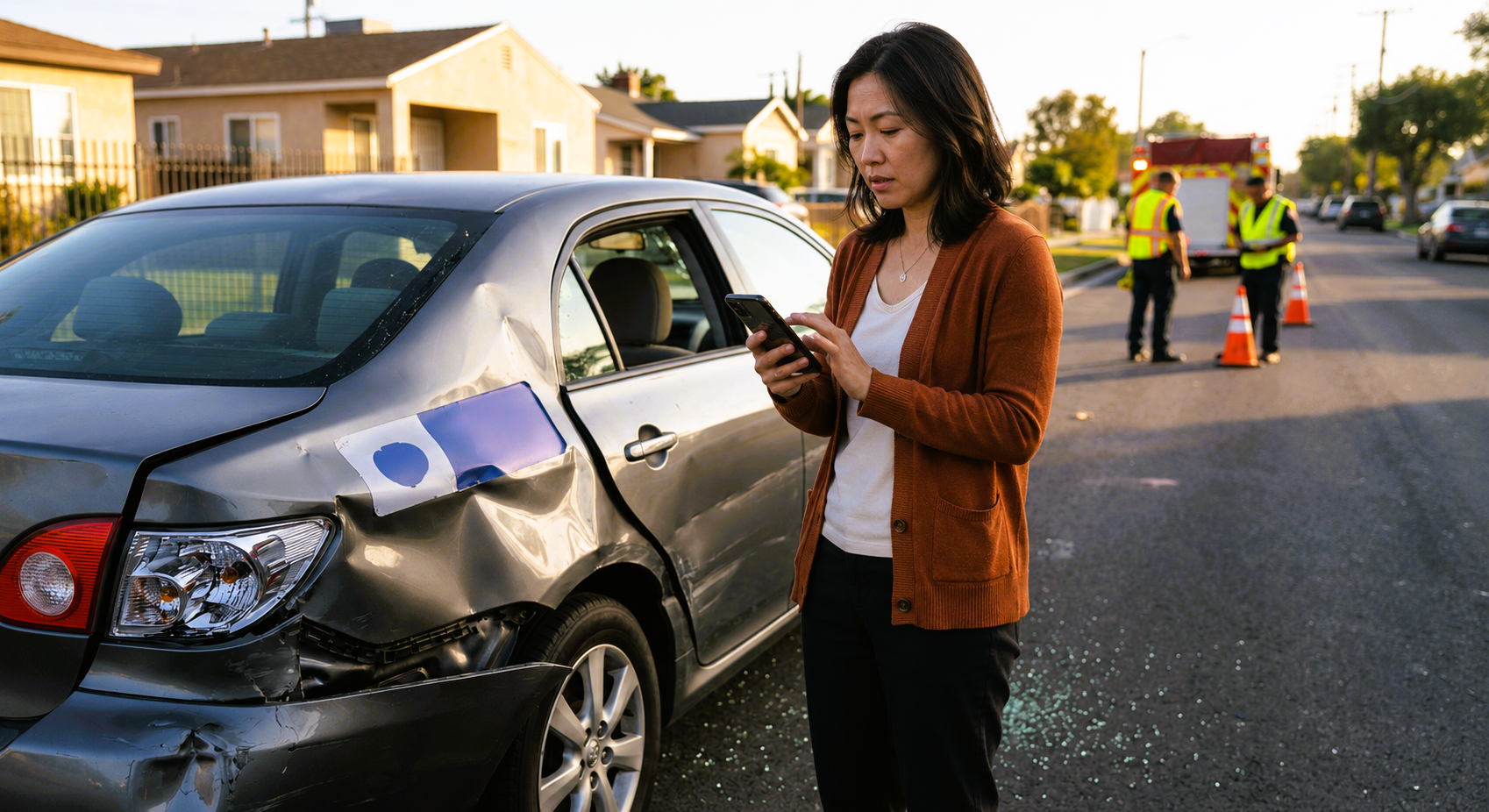
A rideshare crash can involve a passenger, an app-based driver, another motorist, the vehicle owner, and several insurers before the first claim is opened. Responsibility cannot be identified from the Uber or Lyft logo alone.
Tim D. Wright has practiced personal injury law in Southern California since 1983. Uber or Lyft accident liability in California depends on who caused the collision, the driver's status in the app, the injured person's role, and the coverage supported by the records.
Before anybody gets into whether it was an Uber or a Lyft, there's a simpler question sitting in front of it. What did each driver do in the seconds before they hit?
Speed. Following distance. Whether somebody turned across traffic or changed lanes without checking. Signals, or the lack of them. Where the driver was looking. Whether a phone was in his hand. What the road was doing that night and who actually had the right of way. Those are the same things that decide fault in any collision, and they don't stop mattering because there's a rideshare app involved.
A passenger is not required to choose a responsible driver at the scene. The rideshare driver may have made an unsafe turn, another vehicle may have run a light, or both drivers may have contributed to the crash.
A pedestrian, cyclist, or person in another vehicle may also be injured by a rideshare driver. The injured person's role affects which evidence and policies are relevant, but it does not replace the need to prove unsafe conduct, causation, and damages.
Get photos of both cars and the plates, the damage, the road, the signals, the lane markings, wherever the pickup was meant to happen, and any company sticker or placard you can see. Track down whoever saw it and get their number. Ask for the police report number before you go. And keep everything medical, because that's what ties the crash to what it did to you.
The firm's car accident practice evaluates the driving evidence before analyzing coverage. A large commercial policy does not prove fault, and proof of driver negligence does not by itself establish which policy must respond.
This is where rideshare cases stop looking like ordinary car crashes. California breaks a driver's night into stages, and the coverage shifts as they move from one to the next.
Public Utilities Code section 5433 sets what has to be in place at each point. Whether the driver was logged into the platform at all. Whether a ride had been accepted. Whether a passenger was already in the car. Those distinctions sound small from the outside, but they can be the difference between a personal auto policy and something considerably larger.
When the app is off, the collision is generally evaluated through the driver's personal automobile coverage and any other applicable policies. A rideshare company policy should not be assumed to apply merely because the driver sometimes works through the platform.
When the app is on and the driver is waiting for a match, California requires a different level of primary coverage. The current California Public Utilities Commission summary identifies at least $50,000 per person, $100,000 per incident, and $30,000 for property damage for this period.
After a match is accepted and while the driver is traveling to the pickup, the statutory structure requires higher primary commercial coverage. The same high-level layer continues during the passenger trip, although the exact coverages, exclusions, deductibles, and claim facts must be reviewed.
Uninsured and underinsured motorist coverage can come into play during certain rideshare periods too, which is worth knowing if the other driver turns out to have nothing. But don't take a company's word for what applies. Read the actual policy, pull the app records and the trip status, and check it against what the statute requires, because the summary sitting on a rideshare website is written for marketing and not for your case.
If another motorist caused the crash, that driver's liability insurer may be the first source evaluated. The rideshare policy may still require review when the injured person was a passenger or when uninsured or underinsured motorist protection could apply.
If the rideshare driver caused the collision, the driver's personal and platform-related coverage positions may differ based on app status. Personal insurers may investigate whether the vehicle was being used for commercial activity and whether the policy includes a rideshare endorsement.
Who owns the car can matter here. California recognizes permissive use, so if the driver had the owner's permission to be behind the wheel, whether that was said out loud or just understood between them, the owner can get pulled into the claim. Think of a driver borrowing a roommate's car to work a shift. That said, owning the vehicle does not hand anyone unlimited liability. What the statute says, what the policy covers, and what actually happened still have to be looked at before the owner ends up on the hook for anything.
Suing Uber or Lyft directly is a different thing from filing under the coverage that sits behind a rideshare period, even though people tend to hear them as the same move. They are not. Whether the company itself did something wrong, how the driver is classified, how the platform behaved, and what the insurance actually obligates someone to pay are four separate questions with four separate answers. Rolling them into one assumption is how a claim gets aimed at the wrong target.
Sometimes the evidence points somewhere nobody expected at the start. The other driver turns out to have been on the clock for an employer. A part failed the way parts are not supposed to fail, which puts the manufacturer in the picture. A shop signed off on brakes that should not have passed. Or the road itself was the problem, which brings in whatever public entity was responsible for maintaining it. Each of those comes with its own rules and its own filing deadlines, and the deadline for a public entity is usually much shorter than people expect.
Readers seeking a local overview can review the firm's discussion of an Uber or Lyft accident in North Hollywood. The analysis here concentrates on the statewide responsibility and insurance layers rather than a single location.
Save the ride receipt, trip map, driver profile, vehicle description, pickup and destination, fare record, messages, support ticket, and every in-app accident report. Take screenshots, but also retain original emails and downloadable records when available.
Leave the app on your phone. People delete it after a bad ride, and that instinct is understandable, but the account data goes with it. Do not count on the platform holding everything for you either. Account records, location data, phone logs, and the platform's own internal logs each get kept for different lengths of time, and some of that is gone faster than you would guess. A focused preservation request, sent early, is what stops the clock on the pieces that matter.
Public Utilities Code section 5435 addresses cooperation and information exchange during a claims-coverage investigation. That process does not remove the need for the injured person to preserve independent records and document communications.
The cars have something to say too. Where the damage sits tells you the angle two vehicles came together at. Event data recorders capture speed and braking in the seconds before impact. Dashcams and onboard cameras show what a witness would have seen if one had been standing there. Repair records and photographs fill in the rest. All of that still matters even in a case where nobody is arguing about what the app was showing, because how hard the crash was and which direction the force came from are separate questions from who had a ride accepted.
Ask witnesses to describe the driving they observed rather than whether they believe Uber or Lyft is responsible. A witness can reliably report a red light, lane movement, sudden stop, phone use, or point of impact without giving a legal conclusion.
Start a running log the first time an adjuster calls. Claim number, who you spoke with, the date, what they asked you to send, what you actually sent. It takes two minutes a call and it saves you later, because you will end up dealing with more than one insurer and they will circle back to the same ground. Without a record, you answer the same question slightly differently the third time around, or you think you sent something you never did. Neither one helps your claim.
Figuring out which policy applies and how much it is worth is one job, and proving what the crash did to your body is another. The injury side has its own questions. Did this collision cause the condition you are being treated for, or was something already going on? Was the treatment reasonable for what happened? What did it cost you at work and at home, in the things you stopped being able to do? And how much of that can you actually put on paper?
Get seen by a doctor sooner rather than later. That protects you first and the record second, though both matter. Tell them what hurts and be straight about anything that was already bothering you before the crash, because a prior condition you disclose is a footnote while a prior condition they discover is a problem. Follow the treatment plan you are given, and hold onto the bills, the record of work you missed, prescriptions, what it cost you to get to appointments, and any notes you keep about how the recovery is actually going.
At some point an insurer will ask for a recorded statement, or a medical authorization, or your phone information, or access to the app records. Before you agree to any of it, know who is asking. Know which coverage they are looking at. And know how wide the request really is, because a medical authorization written broadly enough will hand them your entire history, not just the parts about this crash.
Stay off social media with it. No trip screenshots, no theories about who the driver was working for, no guesses about policy limits. A post carries none of the context that explains it, and it will sit there waiting to be read against whatever the records turn out to say.
People involved in rideshare collisions within the North Hollywood service area may encounter city streets, freeways, pickup zones, and business cameras. The location may help identify evidence, while California law controls the wider responsibility analysis.
California Code of Civil Procedure section 335.1 generally provides two years for an action involving injury caused by another person's wrongful act or neglect. Other parties, public entities, minors, insurance provisions, and special facts can create different procedures or time limits.
Do not sit around waiting for Uber, Lyft, the driver, and an insurer to agree on what the app was doing. They may never agree, and that argument can run for months while the things you actually need are quietly disappearing. Footage gets recorded over. Digital records age out. Cars get repaired or sold. Witnesses move, change numbers, and forget what they saw. All of that happens well before any filing deadline arrives, which is the part people tend to get backwards.
No two of these cases land the same way. Who was at fault, what the app was showing, whether you were the passenger or another driver or someone on foot, how the policy is written, how badly you were hurt, what it has cost you, and what evidence survived all pull in different directions. An early review can map out which paths are open to you. What it cannot do is promise that a particular company or a particular policy ends up being the one that pays.
No, and that assumption catches a lot of people off guard. What gets paid, and by whom, comes down to whether the driver was actually at fault, what the app was doing at that moment, how far along an accepted ride was, whether another driver contributed to the crash, and what the policies in play actually say. Tim D. Wright puts it this way: seeing a rideshare name on the vehicle tells you where to start looking, not who is going to write the check.
California's transportation network company insurance requirements change depending on whether the app was off, on while waiting for a match, or connected to an accepted or active trip. Receipts, logs, timestamps, and platform records may establish the correct period.
Yes. A rideshare driver and another motorist may both play a part in a collision, and different liability or uninsured-motorist coverages may require review. Each driver's conduct and each policy must be evaluated separately.
The Law Offices of Tim D. Wright offers a free consultation and can compare the collision evidence with app records, trip status, insurers, injuries, and deadlines. The firm cannot identify a responsible policy or predict a result without the records from the individual crash.
A ride receipt can identify the trip, but it may not preserve every log or answer which driver caused the collision. Request a free consultation with the Law Offices of Tim D. Wright by calling (323) 379-9995 or using the contact page to discuss the crash, app status, insurance layers, and evidence that may need attention.


