

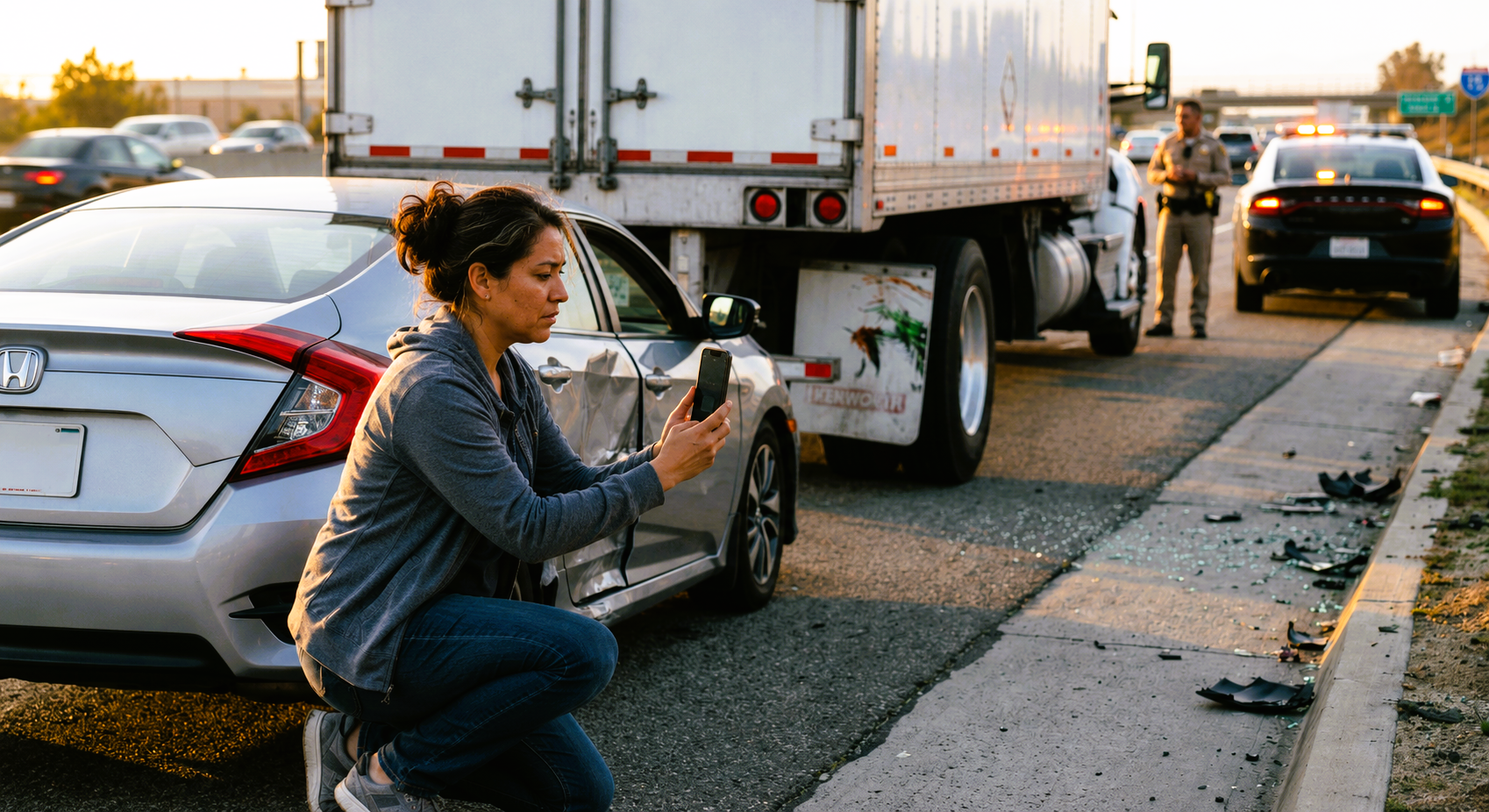
A collision with a commercial truck can look like a larger version of an ordinary car crash. The legal investigation often shows otherwise, because the vehicle may be connected to a driver, a motor carrier, a trailer owner, a shipper, a maintenance provider, and several layers of records.
Tim D. Wright has practiced personal injury law in Southern California since 1983. A truck accident claim in California may require state negligence principles and federal motor carrier rules to be examined together, while every conclusion still depends on the evidence from the specific crash.
Right after a collision, three things matter most: staying safe, getting medical help, and reporting what happened. Call 911 if anyone might be injured, then do what the dispatcher or responding officers tell you.
Getting clear of moving traffic is smart, but only if you can do it without putting yourself at greater risk. If moving means stepping into an active lane, stay put and wait for help to arrive.
You can photograph the truck, tractor, trailer, company markings, license plates, vehicle positions, and damage. A wide scene photograph can establish lane placement, while a close image may preserve a number or mechanical condition that identifies the correct business later.
You can ask the witnesses what they personally observed before impact. A witness may have seen the truck drift, change lanes, brake late, lose cargo, swing wide, or enter an intersection after the signal changed.
You cannot climb in the truck, open equipment compartments, or argue with the driver about logbooks or company policy. Record what is visible from a safe place, obtain the police report information, and allow commercial records to be requested through lawful procedures.
The records should also include your injuries and treatment. Photos of the vehicle damages may explain the force and direction of the impact, but the medical documentation is necessary to connect the collision to the harm being claimed.
The truck driver may be one part of the responsibility analysis, but not the only part. California Civil Code section 2338 states that a principal can be responsible to third persons for an agent's negligence in the transaction of the agency's business, so the driver's work relationship and purpose of the trip may matter.
The owner of the tractor or another motor vehicle may also require review. Under California Vehicle Code section 17150, an owner can be liable for injury resulting from a negligent or wrongful act in the operation of the vehicle by a person using it with express or implied permission, subject to the law and facts that apply.
The other possibilities depend heavily on what actually caused the crash. A defective brake or tire could point the finger at a maintenance contractor, shifting cargo might implicate the loading company, and if there's solid evidence of a component failure, the manufacturer could find itself pulled into the picture as well.
A logo on the side of the truck rarely tells the full story. The tractor and trailer can belong to entirely different entities, the driver may be operating under a lease or contract arrangement, and a single shipment can pass through several businesses before it ever reaches the scene of the collision.
This is one reason the firm's truck accident practice evaluates the identities, contracts, ownership records, and conduct connected to the trip. Naming a business without evidence is not enough, and every potentially responsible party must be tied to a recognized legal basis.
Federal rules create records that may not exist in a private passenger vehicle claim. 49 CFR Part 391 establishes minimum driver qualifications and duties for covered motor carriers and commercial drivers, with exceptions that must be checked before assuming a rule applies.
49 CFR Part 395 governs hours of service for covered drivers. Depending on the operation, electronic logging data, duty records, dispatch information, fuel receipts, toll records, and delivery times may help evaluate whether fatigue or scheduling pressure had a connection to the crash.
Maintenance falls under its own separate track. Under 49 CFR section 396.3, covered motor carriers and intermodal equipment providers must systematically inspect, repair, and maintain any vehicles or equipment under their control - and keep the required records to prove it.
A driver's background can open up entirely new avenues of investigation. Records like training history, licensing, safety performance evaluations, road-test documents, bills of lading, weight records, seal information, and cargo securement materials all help paint a clearer picture - revealing who was responsible for what, and whether any known issues existed before the vehicle ever left the yard.
Regulatory files are only one piece of the picture. Modern trucks carry a lot of data, and much of it survives the crash.
The electronic control module records what the engine and brakes were doing. Onboard cameras may have captured the seconds before impact. Collision-avoidance systems log their own warnings and interventions, and GPS history, dispatch messages, and telematics can reconstruct where the truck was, how fast it was moving, and what the driver was told to do.
Taken together, that data tends to paint a far clearer picture than any paperwork filed after the fact.
Every source has its limits. A log might show that a driver exceeded duty hours, but that alone doesn't prove fatigue played a role. A maintenance entry might document a repair, yet that's a far cry from establishing that a defect caused the crash. And electronic data? It only tells part of the story - the rest depends on understanding the specific vehicle and the roadway conditions surrounding the event.
Readers who want more background on why commercial truck crashes differ from passenger vehicle cases can review the firm's related article. The discussion here concentrates on how those differences shape the parties, records, and preservation work in a claim investigation.
A trucking business continues operating after a collision. A tractor may be repaired, a trailer may return to service, cargo may be delivered, electronic information may be overwritten, and video may be retained for only a limited period.
A focused preservation request can identify the categories of information that should be kept, but it must be directed to the correct entity. This is why the carrier name, truck number, trailer number, plate, insurance information, and police report details are valuable from the beginning.
How that evidence is handled matters as much as what it contains. Copies need to trace back to their original source. Electronic exports should preserve whatever metadata came with them. Inspections should document the condition of the parts before anyone repairs, replaces, or otherwise alters them.
The reason is simple. A record that cannot be tied clearly to a specific truck, driver, trip, or window of time loses much of its persuasive value, no matter how damaging it looks on its face.
Preserve your own evidence in original form. Keep unedited photographs and videos, medical records, bills, wage information, towing papers, repair documents, insurance correspondence, and notes about how the injuries alter daily activities.
Do not post guesses about speed, fatigue, drug use, or mechanical failure on social media. A conclusion should be supported by records, physical evidence, witness observations, and qualified analysis instead than by the size of the truck or assumptions about the industry.
Insurers often ask for a detailed recorded statement early, sometimes before any of the commercial evidence has been collected. That timing is not accidental.
Read what is actually being requested before agreeing to anything. Stick to the facts you know for certain. Resist the pull to guess at speeds, distances, or timing, because an offhand estimate given from memory can end up contradicting video footage, scene measurements, or the truck's own electronic data later on.
California Code of Civil Procedure section 335.1 gives plaintiffs two years to bring an action for injuries caused by another person's wrongful act or neglect. That said, the actual deadline in any given case can shift depending on who the defendants are, whether a government entity is involved, what contracts might be in play, and a range of other factors. The two-year period is a starting point, not a guarantee.
An investigation should not wait for the filing period to approach. Commercial data and physical evidence may change far sooner, and identifying the proper firms can take time when ownership and operating relationships are layered.
People hurt in commercial vehicle collisions near the firm's office can review the Burbank service area, while similar issues can arise in Glendale and North Hollywood. California and federal rules may apply differently depending on the vehicle, route, carrier, and type of commerce.
The results may vary by case because responsibility, causation, damages, available insurance, and the quality of the evidence are never identical. The safest approach is to preserve the record and obtain advice based on the actual truck, trip, businesses, and injuries involved.
A commercial trip may involve separate entities that employ the driver, own the tractor or trailer, load the cargo, maintain equipment, or arrange transportation. Tim D. Wright explains that each entity must be connected to the crash through evidence and an applicable legal theory rather than added simply because it appears in a business record.
Electronic data may show speed, braking, location, or other recorded events, but it rarely answers every question by itself. The data must be preserved, authenticated, interpreted correctly, and compared with scene evidence, witness accounts, and vehicle damage.
Not necessarily. Federal motor carrier rules come with their own set of definitions, coverage provisions, and carve-outs - and some operations fall primarily under California requirements instead. Before treating any specific federal rule as controlling, the vehicle, carrier, route, cargo, and type of commerce all need to be pinned down first.
The Law Offices of Tim D. Wright maintains its primary personal injury office in Burbank and offers a free consultation. The firm can review the available facts, but no article can determine responsibility or predict a result without the evidence from the individual collision.
Commercial evidence may start changing while your vehicle is still being evaluated. Request a free consultation with the Law Offices of Tim D. Wright by calling (323) 379-9995 or using the contact page to discuss the truck, the businesses involved, and the records that may need to be recognized promptly.


