

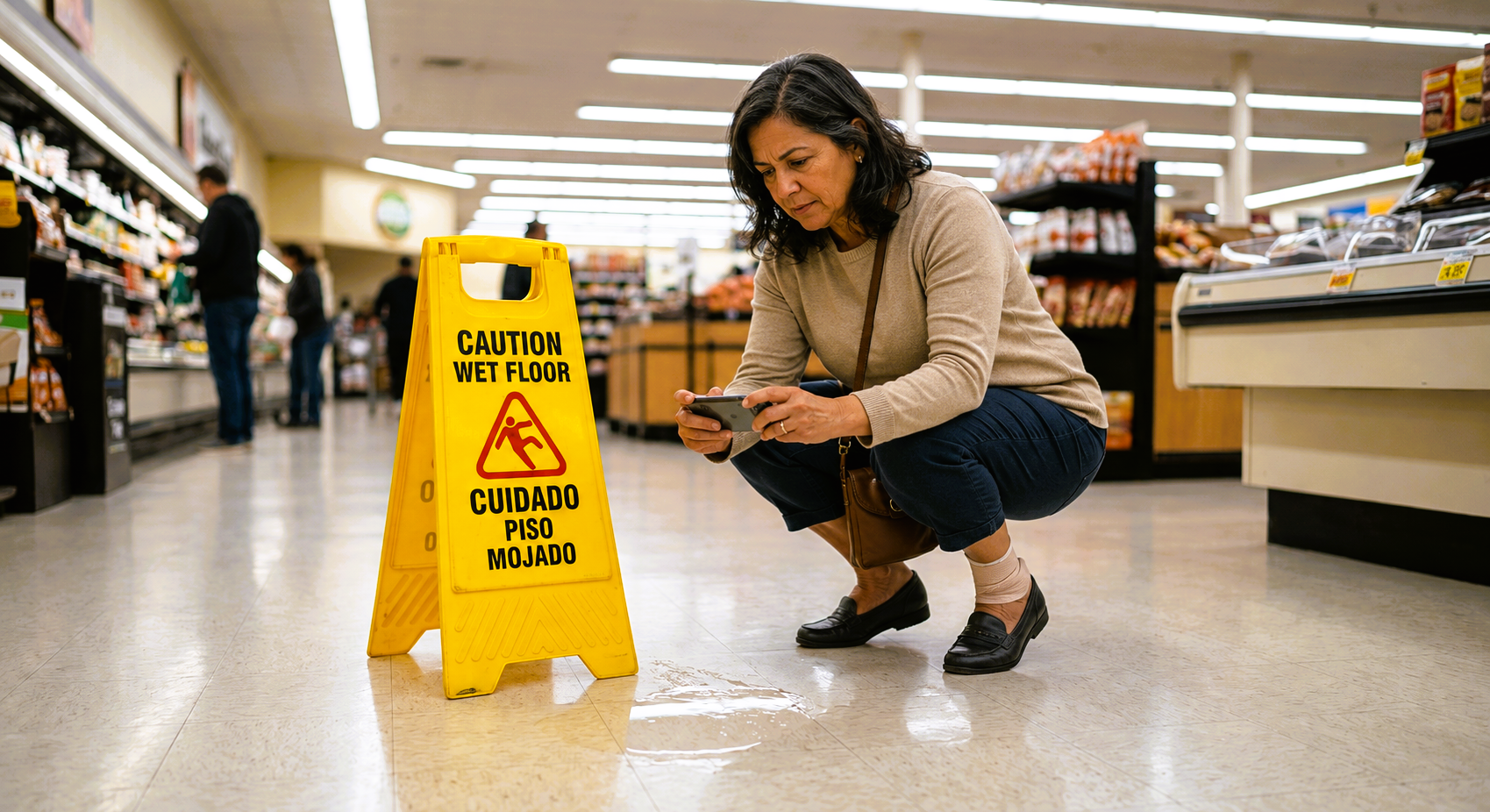
A fall can happen in a few seconds, but deciding legal responsibility usually takes more than identifying a wet floor, broken step, or uneven walkway. The central questions are who controlled the area, what made it unsafe, whether the condition should have been discovered, and how the injury occurred.
Tim D. Wright has practiced personal injury law in Southern California since 1983. Slip-and-fall fault in California is evaluated based on the condition of the property and the conduct of everyone involved, not on the fact that someone fell or was hurt.
Say there's a puddle in a grocery store aisle. You go down hard, and you figure the store owes you something, because it was their floor and their mess. But that isn't how it works in California. A premises liability claim is a negligence claim, so you have to show four things: that they owed you a duty of reasonable care, that they didn't meet it, that this is what caused you to fall, and that you were actually hurt.
Now, if the puddle had been sitting there for two hours while employees walked past it, that's one case. If a customer dropped a jar thirty seconds before you turned the corner, it's a different one. Same fall, different answer. And the person or business you name has to be the one that owned, occupied, leased, or controlled that spot, which isn't always the name on the sign out front.
California Civil Code section 1714 states a broad rule that a person is responsible for injuries caused by a lack of ordinary care in managing property or person, subject to the statute and applicable law. That rule does not make every property controller an insurer of visitor safety.
Control is where a lot of these cases get decided, and the reason is simple. Responsibility tends to follow whoever could actually do something about the hazard, meaning inspect it, fix it, keep people away from it, or at least put up a warning.
So the owner of a building might be on the hook for the lobby and the parking lot, while a tenant answers for what happens inside their own unit. And if a contractor is in there tearing up flooring, they may control that space for as long as the work is going on.
Why you were there and where you happened to be standing can factor in as well. Someone shopping in an open aisle is in a different position than someone who went through a locked door into a service area that customers aren't supposed to enter. Those categories do carry some weight in the analysis, but they aren't the whole thing, and a case doesn't get won or lost on the label alone. What the court comes back to is whether reasonable care was used under the circumstances.
Before anyone gets blamed, the firm's slip and fall practice works out who was actually running that piece of property. It sounds like a technicality. It usually isn't.
Deeds and leases show who holds what. Maintenance agreements and vendor contracts show who was supposed to be handling the cleaning, the repairs, the parking lot. Incident reports and testimony fill in what people were doing day to day, which is often a different picture than the paperwork suggests. Somewhere in there is the party who had real responsibility for the spot where you fell.
"The floor was dangerous" tells nobody anything. It's the kind of line that sits in a claim file doing no work at all.
Compare that to a description someone can picture. Clear liquid across two tiles, the kind you don't see until you're in it. A stair nosing that had worked itself loose. One section of walkway sitting maybe an inch proud of the next. A step with the light burned out above it. Boxes shoved halfway into the aisle. Each of those points at something that either got missed on an inspection or never got fixed, and that's the difference between a description and evidence.
Then you have to tie that condition to the fall itself. This is where scuff marks on the floor, objects that got knocked out of place, what you were wearing, video, what witnesses saw, your medical history, and even where on your body you got hurt all come into play. Those details help separate a trip over a raised edge from a fall that happened for some other reason entirely.
People also tend to assume a warning sign ends the discussion. It doesn't. Where the sign was placed, whether anyone could actually see it, what it said, how far it sat from the hazard, how well lit the area was, and whether there was a safe way to get around the problem all shape what that sign really told people.
A hazard being obvious doesn't automatically end the conversation. It's a common assumption, and it's wrong often enough to be worth flagging.
The 2026 California civil jury instructions cover this ground. There are premises liability instructions for dangerous conditions, for notice, and for hazards a person might reasonably be expected to notice on their own. But which instruction a jury actually hears comes back to what the evidence shows and what's genuinely in dispute. That gets sorted out case by case, not by a rule you can apply from the outside.
The useful question is not whether a hazard can be named after the fall. It is whether the condition created an unreasonable risk under the actual circumstances and whether a responsible person failed to take reasonable measures before the injury.
Here's the thing about notice. If the owner or one of their employees is the reason the hazard existed in the first place, you often don't have to prove they knew about it, because creating it and knowing about it are the same act.
A floor that was mopped minutes earlier. A display someone set up in the middle of a walkway. A ladder or toolbox left sitting there after a repair got finished. In each of those, the hazard traces back to something a specific person did, and that connection does the work for you.
When no one knows who created the condition, the investigation may turn to actual or constructive notice. Actual notice can come from a complaint, employee observation, a prior incident, a repair request, an email, or an inspection entry.
Constructive notice is a different question. It asks whether the hazard was there long enough that someone doing a normal inspection would have seen it and dealt with it. Now, you usually can't answer that on your own, because you weren't in the store before you fell, so you don't know if that spill had been sitting for two minutes or twenty. This is why the rest of it matters so much. Cleaning schedules, sweep logs, timestamps, video, who was working that section, and what employees say about how inspections actually get done in practice. That's where the answer tends to come from.
Missing paperwork cuts both ways, and neither side should read too much into it. If there's no sweep log, that alone doesn't prove anybody was careless. And a log with every box ticked doesn't mean the floor was actually clear at the moment you came through, because somebody initialing a sheet at the top of the hour tells you very little about what the aisle looked like at twenty past.
That's why the records only mean something next to everything else. What time it happened, where exactly, who was working that section, what condition the place was in according to the video and the photos. Line those up against the paperwork and you start to see whether the log matches what was really going on.
Readers needing a scene-focused checklist can review the firm's guidance on how to protect yourself after a Burbank slip and fall. The fault analysis here goes further by connecting the hazard to control, notice, causation, and comparative responsibility.
The insurer isn't going to focus only on what their side did wrong. They'll look at you too. Maybe they'll say the hazard was right there in plain sight and you should have seen it. Maybe there was a sign you walked past. They might point to your shoes, or the fact that you were looking at your phone, or that you'd wandered somewhere customers don't normally go.
Some of that can matter, but none of it is automatically true just because an adjuster says it. Each one has to be backed up with something real, and it has to be looked at in context. A sign doesn't help much if it was facing the wrong way. Being on your phone isn't the same as being careless. These arguments get raised early because they're useful for pushing a claim's value down, not because they end the case.
California uses comparative fault, which means responsibility can be split up when more than one person's negligence played a part in what happened. So if a jury decides you could have been paying closer attention, that can bring your damages down. What it doesn't do is wipe out the other side's failures. If they never inspected the area, never fixed the problem, or never bothered to warn anyone, that's still on them, and it stays in the case even when some of the fault lands on you.
Visibility depends on more than whether the condition appears in a photograph taken later. Lighting, reflections, crowding, aisle layout, color contrast, the direction of travel, merchandise displays, and the person's reason for looking elsewhere may all affect whether the hazard was reasonably noticeable.
Accuracy is more useful than defensiveness. Record what you were carrying, where you were looking, your pace, your route, your footwear, and anything that obstructed the view, then allow those details to be tested against video and physical evidence.
Nobody expects you to know how long that spill sat there. So when someone asks, say you don't know. The temptation runs the other way, especially on the phone with an adjuster who wants a number, and people end up guessing at things they were never in a position to see. Same with whether you spotted the hazard before you went down. If you didn't, you didn't.
Keep the two things apart. What you remember is one thing. What you worked out later, after talking to a witness or seeing the layout again, is something else. Records surface eventually, and a statement built on real memory holds up against them. One built on a guess has to get corrected, and that correction is what the other side works with.
Find the manager. Or the owner, or the landlord, or whoever it is that answers for the place, and tell them what happened. Do it while you still can, because nobody leaves a spill on the floor for long. That broken step might be patched by dinner.
Ask them to put down where it happened and what time. Get a copy if they'll hand you one, or at least a reference number you can point back to later.
Then read what they wrote before you walk out. If the report puts your fall near the entrance and you actually went down by the freezer aisle, that's worth fixing now instead of six months from now.
Get the hazard up close first. Then back up and shoot it again from wherever you were coming from, so the photo shows what you could and couldn't see on your way in.
After that, widen out. Lighting overhead, warning cones if there were any, cameras, where the flooring changes, stairs and handrails, displays, weather, drains, footprints, cart tracks. Shoot the whole path through the property while you're at it. A close-up of a wet floor proves there was water. It doesn't prove anybody walking that aisle had a reason to look down.
Collect contact information from witnesses while people are still standing around. That includes employees who showed up after you fell and anyone who was in the area beforehand.
Somebody who never saw you go down can still be the most useful person you talk to. They might know when that spill appeared, whether a warning sign got moved, or how often anyone came through to check.
None of this waits for you. Video gets recorded over, spills get cleaned, steps get repaired, and the crew working that shift rotates out.
A focused preservation request is how you freeze it in place. Surveillance, inspection records, work orders, photos, complaints, prior incidents at the same spot, vendor paperwork, and internal messages about the condition all go on that list.
Whatever you were wearing, leave it alone. Don't wash the shirt, don't scrub the shoes, don't throw anything out. Grease on a sole or a tear in a knee can show contact with the exact thing that put you down, and once it's in the laundry, that's gone for good. Bag it and set it aside.
Fall in a Glendale strip mall and you might be dealing with three separate parties before you're done. The company that owns the building. The restaurant that leases the corner unit. The outfit that was resurfacing the parking lot that week. Same goes for apartment complexes, hotels, any place where one entity owns the property and somebody else runs the day-to-day.
Knowing the address helps. It tells you which records to chase and who to send the letter to. But it doesn't answer the question that decides the case, which is who had control of that specific spot when you went down, and what the evidence shows about it.
Commercial property may involve an owner, management company, tenant, janitorial vendor, security contractor, repair company, or event operator. Each party's role must be established through evidence, rather than assuming that every business connected to the address shares responsibility.
Residential cases may raise separate questions about common areas, landlord notice, tenant control, lease obligations, and repair requests. A homeowner case may involve the owner, an occupier, a contractor, or an insurer, depending on what created and controlled the condition.
A sidewalk, public building, transit area, park, or government facility may involve a public entity and special procedures. California Government Code section 911.2 generally requires a claim relating to injury to be presented within six months after accrual, subject to other rules and exceptions.
For many injury actions, Code of Civil Procedure section 335.1 generally provides two years. That general period should not be used as an evidence-preservation schedule or assumed to control every property claim.
No two of these cases come out the same way, and the reason is that too many pieces move. Who controlled the area. Whether anyone knew about the hazard. What the condition actually was, how it caused the fall, how much of the fault lands on you, how bad the injuries are, what insurance is behind it, and how much time you have left to file. Change one and the whole picture shifts.
What an early look can do is sort out who should be named and which records need to get pulled before they disappear. What it can't do is tell you a bad floor means somebody owes you money. Those are two different things, and anyone who blurs them isn't being straight with you.
No. A claimant generally must prove an unsafe condition, a duty connected to ownership or control, a failure to use reasonable care, causation, and damages. Tim D. Wright explains that the fact of a fall is evidence that an event occurred, not automatic proof of negligence.
Constructive notice concerns whether a dangerous condition existed long enough that a reasonable inspection would have discovered it. Video, inspection routines, cleaning records, timestamps, employee activity, and witness observations may help evaluate that issue.
A warning sign may be important, but its existence does not decide every case. Placement, visibility, wording, lighting, the location of the hazard, and whether a safe alternative route was available must be considered with the rest of the evidence.
The Law Offices of Tim D. Wright offers a free consultation and can examine the location, responsible parties, condition, notice evidence, injuries, and possible deadlines. No article or initial fact alone can establish fault or predict a result.
A spill may be cleaned, and a damaged surface may be repaired before anyone asks who controlled the area or when the problem began. Request a free consultation with the Law Offices of Tim D. Wright by calling (323) 379-9995 or using the contact page to discuss the property, the evidence, and the deadlines that may apply.


