

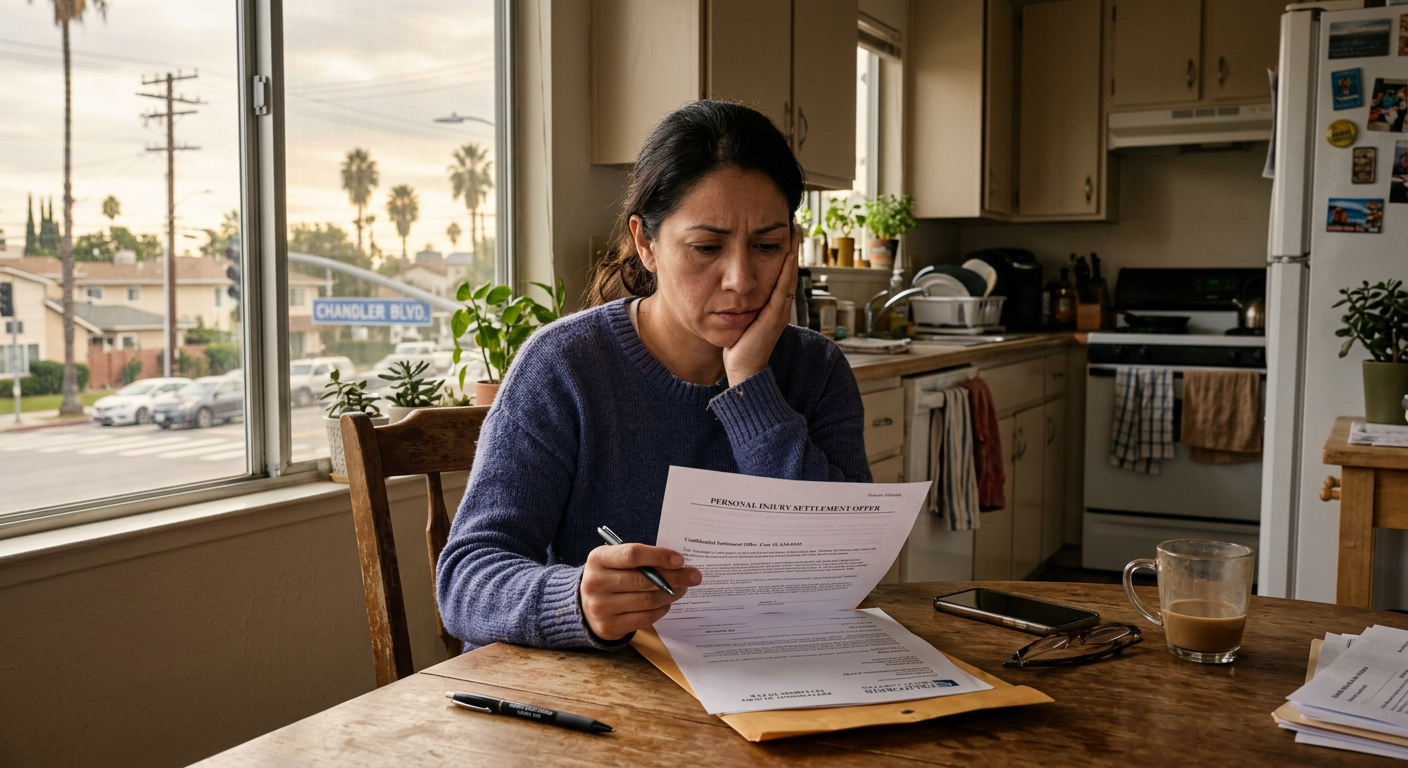
The settlement offer arrived, and the number is more than you expected. Or it arrived, and the number is less. Either way, something about it does not sit quite right, and you are not sure whether that feeling is warranted or whether you are simply unfamiliar with how these things work.
After 34 years of personal injury practice in Southern California, Tim D. Wright has reviewed thousands of settlement offers made to clients across North Hollywood, Burbank, Glendale, and the broader region. In that time, the first offer from an insurance company has almost never been the right one. Once you sign the release that accompanies it, California law makes it extremely difficult to revisit the case regardless of what happens afterward.
A personal injury settlement is not just a payment. It is a contract. The document that accompanies the settlement check is called a release of liability, and signing it is a legal act that extinguishes your right to pursue further compensation from the settling party for the injuries covered by the release.
California law generally treats signed releases as final. If you accept a settlement for injuries you believe are minor, sign the release, and subsequently discover that those injuries are more serious than they appeared at the time, you cannot typically reopen the claim. The release you signed speaks for the parties' agreement, and courts are reluctant to set aside signed releases except in narrow circumstances.
The scope of the release matters significantly. Some releases are limited to a specific incident and a specific party. Others are written broadly enough to cover claims you may not have identified yet. Reading the release language carefully before signing is not optional. It is the minimum due diligence the situation requires.
The initial settlement offer is built around what the insurance company knows about your case at the time they make it. What they know is limited to the documentation they have gathered, which typically reflects your current medical costs and their assessment of liability.
What the first offer typically does not reflect is the complete damage picture. Future medical costs, ongoing pain management needs, lost earning capacity for injuries with long-term effects, and non-economic damages, including pain, suffering, and emotional distress, are consistently undervalued or excluded in initial offers.
Insurance companies also make early offers before the full severity of injuries is established. Many serious injuries do not fully manifest in the first days or weeks after an accident. An offer made before you have finished treatment, before your treating physician has assessed your long-term prognosis, and before a complete damages analysis has been performed is an offer made before the full case exists.
Tim D. Wright reviews every settlement offer received by clients against the complete damages picture that California law makes available. The comparison reveals, in most cases, a meaningful gap between what was offered and what a thorough assessment shows the case is worth.
The process of reviewing an offer is not simply a comparison of numbers. It involves identifying what damage categories were included in the offer, what categories were excluded or minimized, and what additional documentation or medical expert input is needed to establish the full picture.
For clients in North Hollywood, Burbank, Glendale, and across Southern California, Tim D. Wright performs this assessment before any response is made to the insurer. The response to the offer, whether a counteroffer, a rejection, or acceptance, is made from an informed position about what the case is actually worth.
Speed is the most reliable warning sign. An offer that arrives within the first two weeks of an accident, before you have finished treatment and before a complete medical picture is available, is almost certainly based on an incomplete assessment of your damages. The faster the offer arrives, the more likely it is that the insurer is trying to close the file before the full extent of your injuries is known.
Completeness gaps are another. Does the offer address future medical costs? Does it include any amount for non-economic losses? Does it account for lost income beyond what you have already missed? An offer that covers only current bills without addressing the other categories of damages California law allows is a partial offer, regardless of what the accompanying letter says.
Vague release language should always prompt review. If the release is written broadly enough to cover claims beyond the specific incident and injuries at issue, signing it may close rights you did not intend to close. The release should be read as carefully as the offer amount.
A well-drafted release identifies the specific incident, the specific parties, and the specific claims being released. A release that uses language like 'any and all claims, known or unknown, arising out of any event' goes beyond what is necessary to settle the claim at hand. This broader language protects the insurer at the expense of the claimant, and it appears in more releases than most people expect.
California Civil Code Section 1542 provides that a general release does not extend to claims the releasing party does not know about at the time of signing, unless the release specifically waives Section 1542 protections. Many insurance releases include an explicit 1542 waiver. Understanding what that language means before you sign is essential.
No. In California, a personal injury settlement is not binding until a written release is signed. A verbal expression of interest or a statement that an offer sounds acceptable does not create a binding agreement. Do not confirm acceptance in writing or sign any documents before having the offer reviewed by an attorney. Contact Tim D. Wright before taking any further steps. The verbal conversation does not close your options.
Current medical bills are only one part of what California law allows you to recover. An offer that covers current bills, plus a modest additional amount, may represent a fraction of the full damages picture once future medical costs, lost earning capacity, and non-economic losses are included. The only way to know whether the offer is fair is to compare it to a complete damages assessment. Tim D. Wright performs that assessment for every client who receives an offer.
No. Settlement deadlines presented to unrepresented claimants are almost always artificial pressure tactics rather than genuine legal constraints. The statute of limitations for your claim continues to run regardless of the insurer's internal deadline, and a settlement offer does not expire simply because an adjuster says it does. The time pressure is designed to prevent you from seeking legal review before deciding. Take the time you need to have the offer properly evaluated.
A property damage settlement and a personal injury settlement are separate matters under California law. Accepting compensation for your vehicle does not automatically close your personal injury claim unless the release you signed specifically covers personal injuries as well. Read the property damage release carefully. If it includes language releasing personal injury claims, that is a serious complication that needs to be reviewed immediately. If it covers only property damage, your personal injury claim remains open.
A settlement offer arrives and it feels like a decision that needs to be made now. It does not. The release is permanent. The review that should precede it is not complicated and does not take long.
Tim D. Wright reviews settlement offers for clients across North Hollywood, Burbank, Glendale, and Southern California with a single objective: comparing what was offered to what California law actually makes available. The gap between those two numbers tells the story.
The firm takes cases on a contingency basis. Call (323) 379-9995 or visit timwrightlaw.com/contact before you sign anything. That conversation is exactly what needs to happen before the decision is made.
📍 Burbank Office: 1112 W. Burbank Blvd., Suite 302, Burbank, CA 91506
📍 Van Nuys Office: 16555 Sherman Way, Suite B2, Van Nuys, CA 91406
📞 Phone: (323) 379-9995 (Personal Injury) | (818) 428-1080 (Workers’ Comp)
📧 Email: firm@timwrightlaw.com
🌐 Website: www.timwrightlaw.com
📱 Follow us on Facebook, Instagram, and Twitter


