

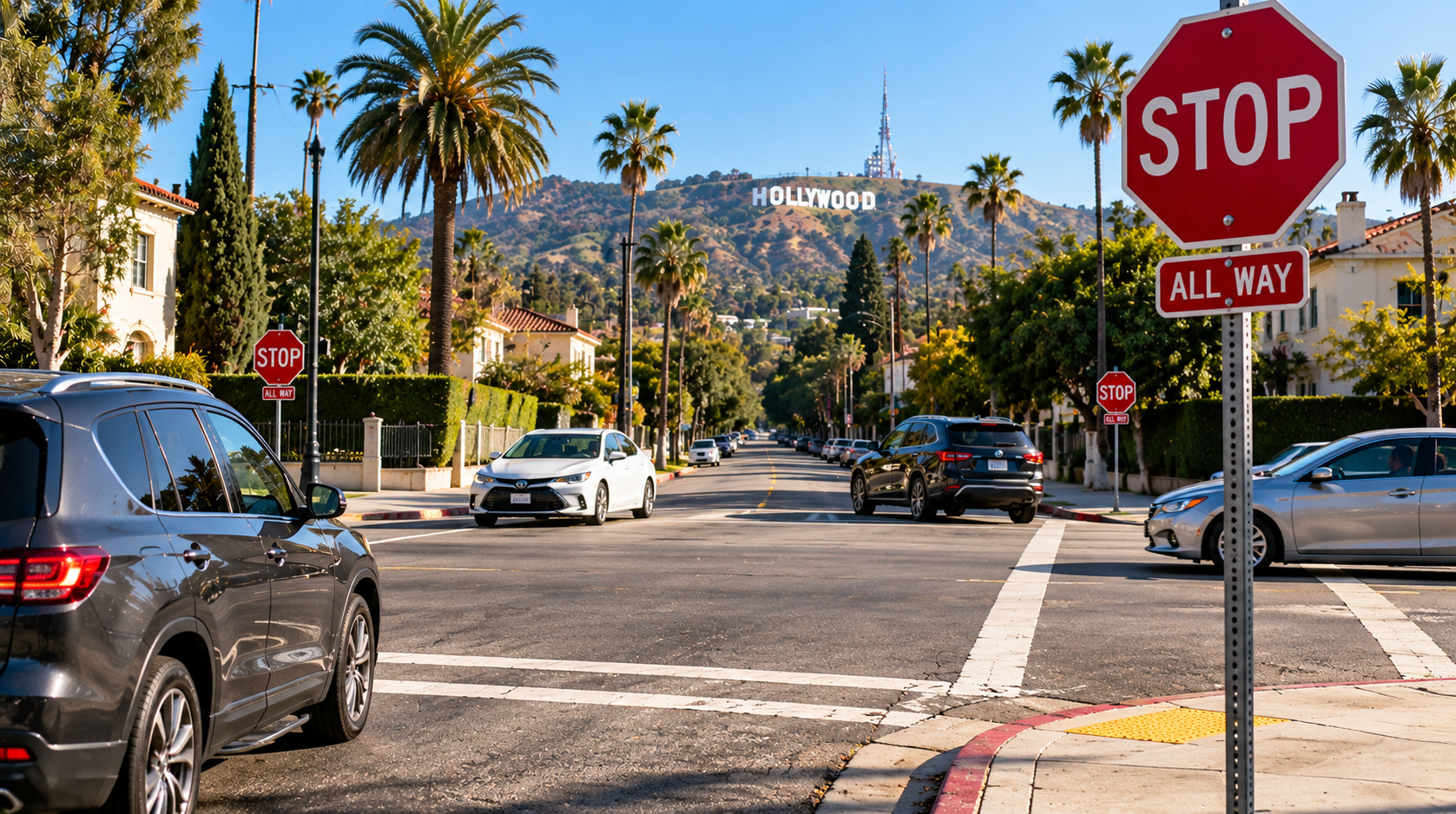
Four-way stops are common throughout California, from residential neighborhoods to busy city streets. They seem straightforward, but confusion over who should go first can quickly lead to hesitation—or a collision.
Knowing the four way stop rules can help you navigate these intersections more safely and understand what may matter if an accident occurs.
At a four-way stop, every driver must stop at the appropriate limit line, crosswalk, or point required by California traffic law before proceeding.
Once stopped, drivers need to pay attention to the other vehicles, pedestrians, and bicyclists already at or entering the intersection.
As a practical rule, the vehicle that reaches and stops at the intersection first generally proceeds first. When vehicles arrive at approximately the same time, right-of-way rules become especially important.
If one vehicle clearly arrives and stops before the others, that driver will generally have the opportunity to proceed first, assuming it is safe to do so.
Things become less obvious when two vehicles arrive at nearly the same time.
When vehicles approach from different roads at approximately the same time, California's right-of-way rules generally require the driver on the left to yield to the vehicle on the right.
For example, imagine two cars reach an intersection at approximately the same time from perpendicular streets. The driver who has the other vehicle on their right should yield.
Regardless of who appears to have priority, drivers should never enter an intersection until it is reasonably safe.
Left turns create another potential conflict.
A driver intending to turn left must account for vehicles approaching from the opposite direction and yield when required. This becomes particularly important when another vehicle is proceeding straight through the intersection.
Rather than assuming another driver will stop or yield, drivers should make sure the intersection is clear before beginning the turn.
Misjudging another vehicle's movement can result in a side-impact or car accident, even at relatively low speeds.
Vehicle right-of-way isn't the only consideration at a four-way stop.
Drivers must also watch for pedestrians in crosswalks and exercise appropriate care when approaching them. A driver shouldn't proceed simply because it appears to be their "turn" among the vehicles if doing so would endanger someone crossing the street.
This is especially important at intersections where parked vehicles, poor visibility, heavy traffic, or other conditions make pedestrians harder to see.
Bicyclists traveling on California roads generally have many of the same rights and responsibilities as motorists.
That means a cyclist approaching a stop sign generally must stop and follow applicable right-of-way rules as well.
Drivers should avoid assuming a cyclist will behave differently simply because they're riding a bicycle. Predictable behavior from everyone at the intersection can help reduce confusion.
Even experienced drivers make mistakes at stop-sign intersections. Some of the most common include:
A simple misunderstanding doesn't necessarily determine legal responsibility by itself. If a collision occurs, the circumstances leading up to the crash need to be considered.
When two drivers disagree about who entered the intersection first, determining fault can become complicated.
Evidence may include:
The location and type of vehicle damage can sometimes help investigators understand how a collision occurred, but it generally shouldn't be considered conclusive on its own.
Tim Wright Law's car accident attorneys explain that establishing fault can require examining multiple pieces of evidence, particularly when more than one person may have contributed to a crash.
Yes. California follows comparative-fault principles.
An accident doesn't always have to be entirely one person's responsibility. Depending on the circumstances, responsibility may be divided among multiple people, and an injured person's recovery can be reduced according to their share of fault.
For example, one driver might enter an intersection out of turn while another is distracted or traveling unsafely. The evidence would need to be evaluated to determine how each person's actions contributed to the collision.
This is one reason personal injury claims involving disputed intersection accidents can become more complicated than they initially appear.
Start with safety. Check yourself and others for injuries and call 911 when necessary.
If you're able to do so safely, document the scene before important evidence disappears. Photograph the vehicles, intersection, stop signs, road markings, and any visible damage.
You should also exchange information with the other driver and get contact information from anyone who witnessed the crash.
Seeking medical attention is important if you've been injured, even when symptoms don't seem severe immediately after the collision.
A four-way stop accident may be relatively straightforward when there is clear video or reliable witness evidence. Other crashes aren't so simple.
If the drivers disagree about who arrived first, serious injuries occurred, or an insurance company disputes responsibility, an attorney can review the available evidence and explain how California law may apply.
Understanding four way stop rules can make intersections safer. When a collision does happen, understanding those rules can also be an important part of figuring out what went wrong and who may be legally responsible.


