

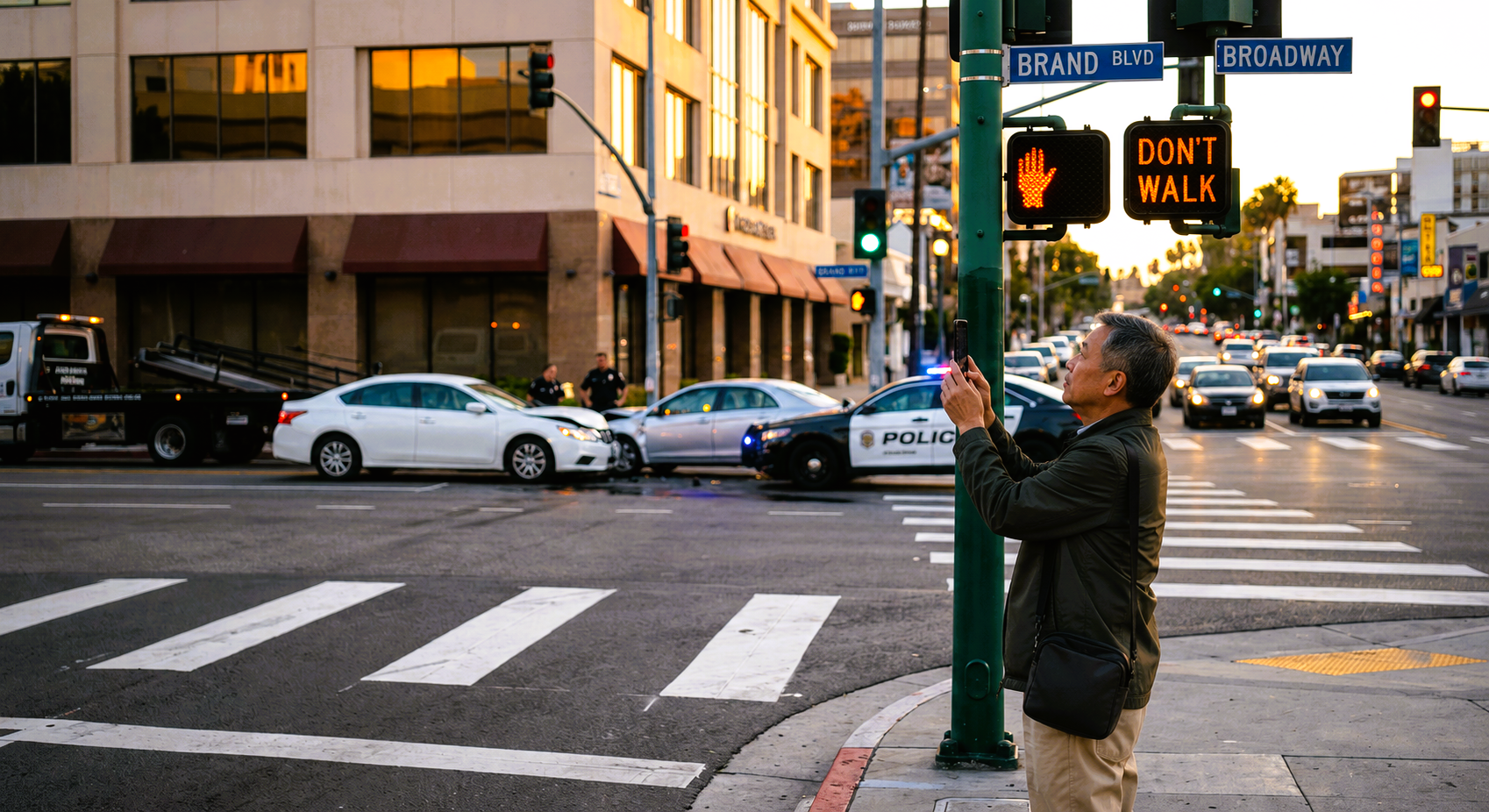
A crosswalk can look ordinary after traffic resumes, even when the collision turned on a few seconds of signal timing, a blocked sight line, or a vehicle's turning path. The strongest local investigation preserves those details before the intersection changes.
Tim D. Wright has practiced personal injury law in Southern California since 1983. A crosswalk accident claim in Burbank or Glendale may depend on scene measurements, video, signal evidence, witness perspectives, medical proof, and the exact movement of the pedestrian and vehicle.
Start with the intersection name, crossing direction, side of the street, marked or unmarked path, curb ramp, median, stop line, lane configuration, and traffic-control devices. A report that says only crosswalk may not identify which movement or signal phase is applied.
Photograph the approach from the pedestrian's eye level and from the driver's direction of travel. Include parked vehicles, landscaping, construction, utility equipment, bus stops, signs, street furniture, shadows, glare, and anything that may have affected visibility.
Record where the pedestrian entered, where contact occurred, where the person and vehicle came to rest, and where debris or personal items landed. These points may help evaluate speed, direction, turning movement, and the opportunity to react.
Do not stand in active lanes to recreate the crash. Use safe public viewpoints, existing photographs, police measurements, video, and a later controlled inspection when more precise documentation is necessary.
Weather and daylight can change quickly. Note the date, time, cloud cover, wet pavement, artificial lighting, sun position, and whether surrounding businesses or trees created contrast that a daytime photograph taken later will not reproduce.
The firm's pedestrian accident practice can organize this location evidence around the movements that matter. A photograph of crosswalk paint is useful only when it is connected to the pedestrian's path, vehicle approach, and traffic controls.
At a signalized crossing, record the symbol facing the pedestrian, any countdown, the traffic lights for the vehicle, protected or permissive turn arrows, and the direction each person was moving. Witnesses may remember one display while facing a different direction, so perspective must be identified.
California Vehicle Code section 21456 describes pedestrian-control signals, including WALK, steady hand, and flashing-hand countdown conditions. Applying the rule requires proof of what the signal displayed when the pedestrian entered and while the crossing continued.
A signal timing plan may identify programmed intervals, but it does not necessarily prove the display at the instant of the collision. Malfunctions, maintenance, time-of-day settings, emergency preemption, and witness or video evidence may need consideration.
Turning vehicles require a detailed sequence. Determine whether the driver turned right or left, whether the vehicle stopped before the crosswalk, which lane it entered from, where the driver was looking, and whether another vehicle blocked the view.
Write down the countdown number or signal color only if you remember it independently. If you are uncertain, say so and identify any camera, witness, or record that may answer the question more reliably.
Readers seeking a wider Burbank liability overview can review the firm's article on a pedestrian hit in a Burbank crosswalk. The discussion here is narrower and focuses on the local evidence needed to test competing accounts.
Look for cameras on businesses, homes, apartment buildings, parking structures, buses, delivery vehicles, dashcams, and public facilities. Record the camera location, viewing direction, possible blind spots, and the time window that should be preserved.
A video timestamp may be fast, slow, or based on a different time zone. Compare it with dispatch records, phone times, receipts, signal cycles, or another known event before treating the displayed time as exact.
A camera facing the pedestrian may not show the driver's signal, while a camera behind the vehicle may hide the person behind the windshield pillar. Several partial views can be more reliable than one clip interpreted without its limitations.
Ask the owner to preserve footage promptly, but do not promise that a recording exists or must be released voluntarily. Businesses and public agencies have different systems, retention periods, privacy matters, and procedures for requests.
Keep the original file whenever footage is obtained. Record who supplied it, the date, the export method, the camera location, and whether the clip is complete or shortened so the source can be explained later.
Do not edit the only copy, add captions that cover the image, or circulate a compressed social-media version as the evidence file. Create a separate working copy for annotations while preserving the source.
Obtain contact information for drivers, passengers, people waiting to cross, nearby workers, residents, and first responders. Ask where each witness stood or sat, what direction the witness faced, and what obstructed the view.
A witness may remember the impact but not the signal that preceded it. Another may have seen the vehicle's turn but not the pedestrian enter the roadway, so statements should be combined carefully rather than treated as interchangeable.
Preserve the witness's own words and avoid rehearsing a preferred account. A short statement identifying the observed movement, signal, speed impression, horn, braking, or distraction can be more useful than a legal conclusion about right of way.
The police report may list witnesses, driver statements, a diagram, measurements, citations, and officer observations. It is an important starting record, but it does not automatically resolve negligence, causation, or comparative fault.
Under California Vehicle Code section 21950, a driver must yield to a pedestrian crossing within a marked crosswalk or an unmarked crosswalk at an intersection, subject to the statute's full terms. The same section addresses pedestrian care and preserves the driver's duty to exercise due care.
Evidence should therefore test both sides of the movement. The relevant record may include pedestrian entry, pace, visibility, signal compliance, vehicle speed, lookout, braking, turn path, and the opportunity each person had to avoid the collision.
Scene evidence explains how the impact occurred, while medical evidence explains the injury. Emergency records, imaging, diagnoses, treatment, referrals, work restrictions, and recovery notes should accurately connect symptoms to the collision.
Preserve damaged clothing, shoes, glasses, phones, bags, mobility devices, and other personal items. Tears, scuffs, fractures, or transferred material may help explain contact and the pedestrian's movement after impact.
Photograph visible injuries over time without using filters. Keep records of medical bills, prescriptions, transportation, missed work, household assistance, and changes in walking, sleep, concentration, caregiving, or daily routines.
Prior conditions should be disclosed accurately. Earlier records may distinguish a stable problem from a new injury, an aggravation, or a new functional limitation following the crosswalk collision.
People injured within the Glendale service area may have evidence held by local businesses, residents, transit providers, or public agencies. The same is true in Burbank, but the specific custodian and request process must be identified for the actual intersection.
Avoid broad claims that a particular intersection is dangerous unless current official data or admissible evidence supports that statement. The individual collision can be evaluated without turning an unsupported local reputation into proof.
A collision may raise questions about signal operation, street lighting, crosswalk maintenance, construction, vegetation, or roadway design. Those facts do not automatically create public-entity liability, and dangerous-condition, notice, causation, immunity, and procedural rules require separate analysis.
California Government Code section 911.2 generally requires a claim relating to personal injury to be presented within six months after accrual. The correct entity, accrual date, exceptions, and later lawsuit procedures must be evaluated promptly.
For many claims against a private driver, Code of Civil Procedure section 335.1 generally provides two years for an injury action. That period does not preserve video, witness availability, scene conditions, or a possible government claim.
A targeted records request may seek collision reports, signal timing information, maintenance records, work orders, permits, complaints, or project documents when they are relevant. Requests should be directed to the correct custodian and time period rather than demanding every record about an intersection.
Results vary by case because the crosswalk, signal, visibility, video, witnesses, driver conduct, pedestrian conduct, injuries, and possible public role are different. Early evidence work can strengthen accuracy without guaranteeing liability or compensation.
Photograph the crossing direction, curb ramps, markings, signals, stop lines, lanes, parked vehicles, obstructions, lighting, vehicle path, impact area, debris, and surrounding cameras from safe viewpoints. Tim D. Wright explains that context as well as perspective are as important as a close image of the crosswalk.
A timing plan may establish programmed intervals, but it may not prove the exact display at the collision time. Video, witnesses, maintenance information, time-of-day settings, and reliable timestamps may also be needed.
No. A report can preserve statements, witnesses, diagrams, measurements, citations, and observations, but civil responsibility still depends on the complete evidence, applicable law, causation, and comparative fault.
The Law Offices of Tim D. Wright is based in Burbank and offers a free consultation. The firm can identify relevant scene, signal, video, witness, medical, and public-record questions, but no evidence source or result can be promised.
A signal cycle repeats, traffic moves on, and video may be overwritten, but the intersection details can decide how competing accounts are tested. Request a free consultation with the Law Offices of Tim D. Wright by calling (323) 379-9995 or using the contact page to discuss the Burbank or Glendale crossing and the evidence that may still be available.


