

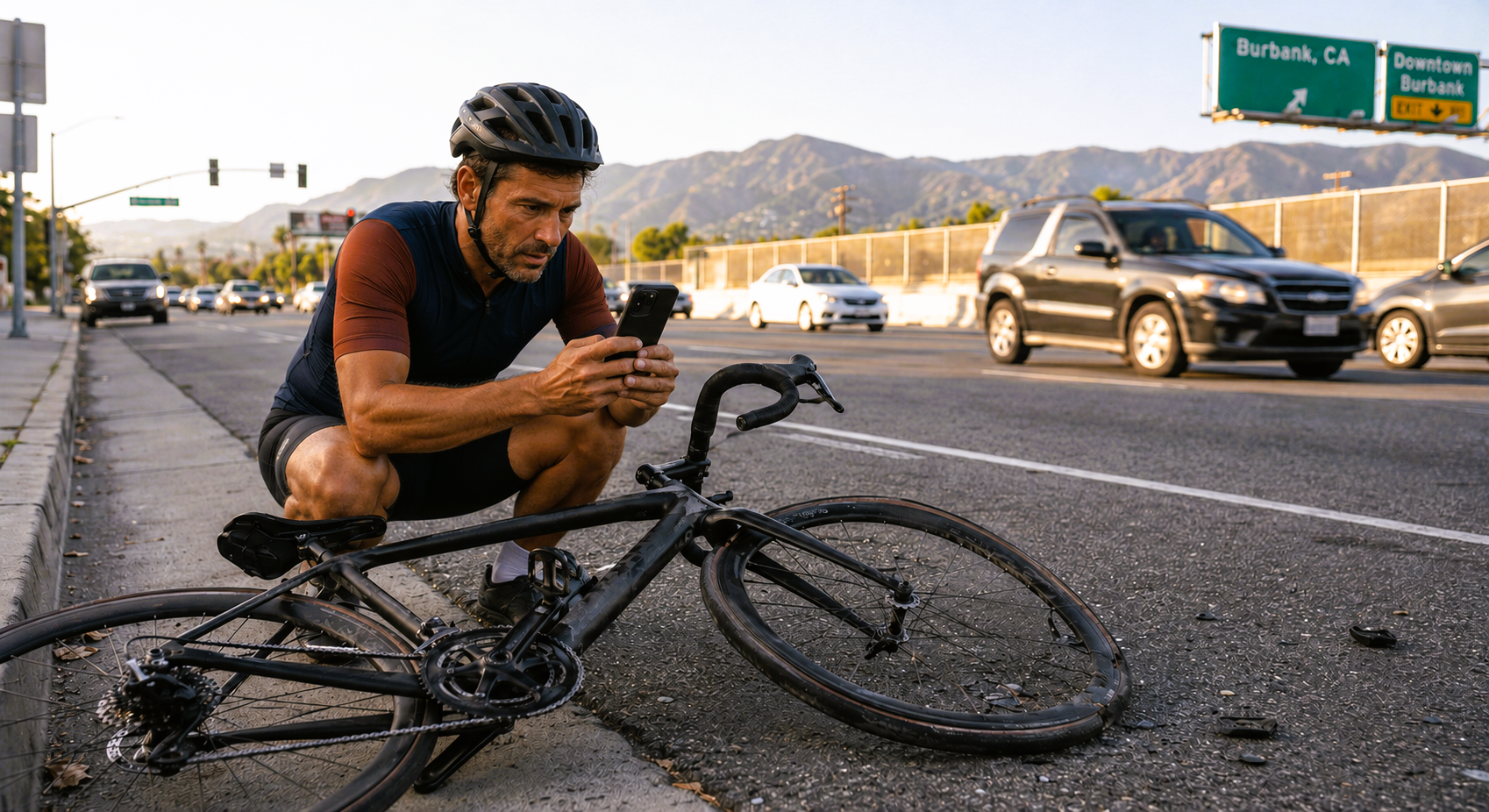
A bicycle can be moved out of the road in seconds, a driver can leave with only a small dent, and the intersection can look normal again before the cyclist reaches the hospital. That quick cleanup can hide the details that later decide how the crash is understood.
Tim D. Wright has practiced personal injury law in Southern California since 1983 and serves clients in Burbank. After a bike accident in Burbank, California, early documentation can help the firm evaluate road position, passing distance, driver movement, injuries, and the rights and duties that applied.
Call 911 when medical help or police response may be needed. Move out of active traffic when it is safe, but photograph the bicycle and vehicle positions first if your condition and the scene allow it.
Take wide and close-up photos of the road, bike lane, curb, parked vehicles, driveways, traffic signals, signs, surface hazards, lighting, debris, skid marks, and damage to the vehicle. Before repairing the bicycle, photograph it from several angles. Pay close attention to bent wheels, frame damage, pedal marks, damaged handlebars, and broken lights.
Get the driver’s name, contact details, insurance information, license plate number, and vehicle information. If anyone witnessed the crash, ask for their contact details and what they saw. Their account should include where the bicycle was, how the vehicle moved, and whether a signal or turn indicator was used.
Look for cameras on businesses, homes, buses, delivery vehicles, and nearby cars. A recording may disappear quickly, and the owner may require a formal request or may decline to release it directly.
The related article on immediate steps after a Burbank bicycle accident provides a practical checklist. This discussion takes the next step by explaining how rights, road position, passing conduct, and preserved evidence may be evaluated.
California Vehicle Code section 21200, cyclists generally have the same rights and must follow the same rules as motor vehicle drivers, except when a rule does not reasonably apply to a bicycle. In other words, cyclists have a legal right to use the road and are protected by California traffic laws.
That rule also means cyclist conduct may be examined. Signals, direction of travel, yielding, lighting, alcohol or drug use, and compliance with applicable traffic controls can become part of the evidence.
A citation does not automatically decide a civil claim. The issue is whether conduct by the driver, cyclist, another road user, a property owner, or another responsible party contributed to the collision and resulting injury.
California’s comparative fault rules allow responsibility to be shared when more than one person’s carelessness contributed to the crash. An insurance company may point to a traffic violation by the cyclist, but that is only part of the investigation. The driver’s speed, attention, passing distance, turn, door opening, and failure to yield must also be considered.
California Vehicle Code section 21202 generally directs a slower cyclist to ride as close as practicable to the right curb or edge, but it lists important exceptions. A cyclist may move left to pass, prepare for a left turn, avoid unsafe conditions, or approach a place where a right turn is authorized.
The law recognizes that cyclists may need to move left to avoid vehicles, pedestrians, animals, poor pavement, fixed objects, or lanes that are too narrow to share safely with a vehicle. Photos of potholes, parked cars, construction zones, debris, or narrow lanes can help explain why a cyclist was riding farther from the curb.
Under California Vehicle Code section 21208, cyclists traveling slower than surrounding traffic generally must use an available bike lane. They may leave it to pass, prepare for a left turn, avoid a hazard, or approach an area where right turns are allowed. Before moving out of the lane, the cyclist must make sure it is reasonably safe and signal when the movement could affect another vehicle.
These rules are fact sensitive. A still photograph taken after the bicycle was moved cannot establish the entire route, so witness observations, video, road measurements, and the cyclist's accurate recollection may be needed.
California Vehicle Code section 21760 requires a motorist overtaking a bicycle to pass at a safe distance and generally not less than three feet. When another lane in the same direction is available, the driver must make a lane change before passing when it is practicable, safe, and lawful.
If three feet cannot be provided because of traffic or roadway conditions, the driver must slow to a reasonable and prudent speed and pass only when the movement will not endanger the cyclist. The vehicle's size and speed, traffic, weather, visibility, and roadway width all matter.
A collision caused by a vehicle passing too closely is different from one involving an opened car door. In a dooring crash, the investigation may focus on who opened the door, whether they checked for approaching cyclists, where the bicycle was traveling, what each person could see, and whether the cyclist had enough time to avoid the collision.
Crashes at intersections must be examined based on the events leading up to them. A driver turning right across a bike lane faces a different situation from one turning left in front of an approaching cyclist. Stop signs, driveways, traffic signals, and blocked views can also affect what each person saw and how much time they had to react.
The firm's bike accident practice can organize these separate theories rather than treating every bicycle collision alike. The point of impact, bicycle damage, vehicle marks, road design, and movement before the crash should support the theory selected.
The firm can begin by identifying the people involved, available insurance coverage, police reports, witnesses, video footage, medical records, and damaged property. Reviewing this information can show what evidence needs to be preserved and what questions still need answers.
An attorney can evaluate whether a preservation letter, records request, inspection, expert analysis, or formal discovery process may be appropriate. Not every case needs every step, and no specific evidence source is guaranteed to exist or be obtainable.
The roadway record should always be the same as the injury record. Keep medical appointments, describe symptoms honestly, retain bills and work-loss information, and document how the injuries affect mobility, sleep, household tasks, transportation, and other daily activities.
An insurance company may ask for a recorded statement, permission to access records, an inspection of the bicycle, or a signed release. Before agreeing to anything, find out exactly what the request covers, why it is needed, and how the insurer plans to use it.
People who are injured within the Burbank service area may have ridden through nearby North Hollywood, Glendale, or other parts of the San Fernando Valley. Local knowledge can help identify streets and possible evidence sources, but responsibility still depends on the law and facts.
California Code of Civil Procedure section 335.1 generally provides two years for an action involving injury caused by another person's wrongful act or neglect. Public-entity claims, minors, and other circumstances may involve different rules or procedures.
Two years does not mean evidence will remain available for two years. Video may be overwritten, a road condition may be repaired, the bicycle may be discarded, and witnesses may become harder to reach.
A quick review also gives the cyclist time to correct missing report information and identify nearby cameras before ordinary business retention practices remove the footage.
Results vary by case because fault, injuries, causation, damages, insurance, and the available proof differ. Protecting rights begins with preserving what happened, not with assuming that a bicycle lane, citation, or severe injury will answer every legal question.
Sometimes. Vehicle Code section 21208 allows a cyclist to leave a bicycle lane for reasons that include passing, preparing for a left turn, avoiding hazardous conditions, and approaching a place where a right turn is authorized. Tim D. Wright explains that the reason and safety of the movement must be evaluated from the actual road conditions.
Vehicle Code section 21202 uses the phrase as close as practicable and provides exceptions for passing, left turns, hazards, narrow lanes, and right-turn locations. Photographs, video, measurements, parked cars, debris, surface defects, and lane width may show why the bicycle's position was reasonable.
Vehicle Code section 21760 generally prohibits passing at less than three feet and may require a lane change when another same-direction lane is available, and the movement is practicable, safe, and lawful. When traffic or roadway conditions prevent three feet, the driver must slow and may pass only without endangering the cyclist.
The Law Offices of Tim D. Wright can review the collision record, potential parties, insurance information, medical documentation, and evidence that may need preservation. The Burbank firm offers a free consultation, but no particular investigation step or result can be promised before the facts are evaluated.
Your bicycle may be repairable, but repairing it too soon can remove part of the story. Request a free consultation with the Law Offices of Tim D. Wright by calling (323) 379-9995 or using the contact page to discuss the Burbank roadway, the bicycle, the driver, and the evidence that may still be preserved.


